Explore the Makalu Base Camp Trek, the least crowded and untouched wilderness in the Himalayan region of Nepal, far from the crowds to the foot of the world’s fifth-highest mountain at 4,870 meters. Enjoy majestic snowclad Himalayan landscapes, rich flora and fauna, the traditional culture of Rai, Limbu, and Sherpa communities, two demanding high passes, and the wild Barun Valley.
Makalu Base Camp Trek - 18 Days
The Journey to Makalu Base Camp Trek
The Makalu Base Camp Trek is one of Nepal’s natural treasures, where wild Himalayan landscapes, remote trails, and serene mountain villages replace the crowds found on better-known trekking routes. Located in Sankhuwasabha District in eastern Nepal, the 18 Days Makalu Base Camp Trek takes you from Makalu Barun National Park to the foot of Makalu, the world’s fifth-highest mountain at 8,485 meters.
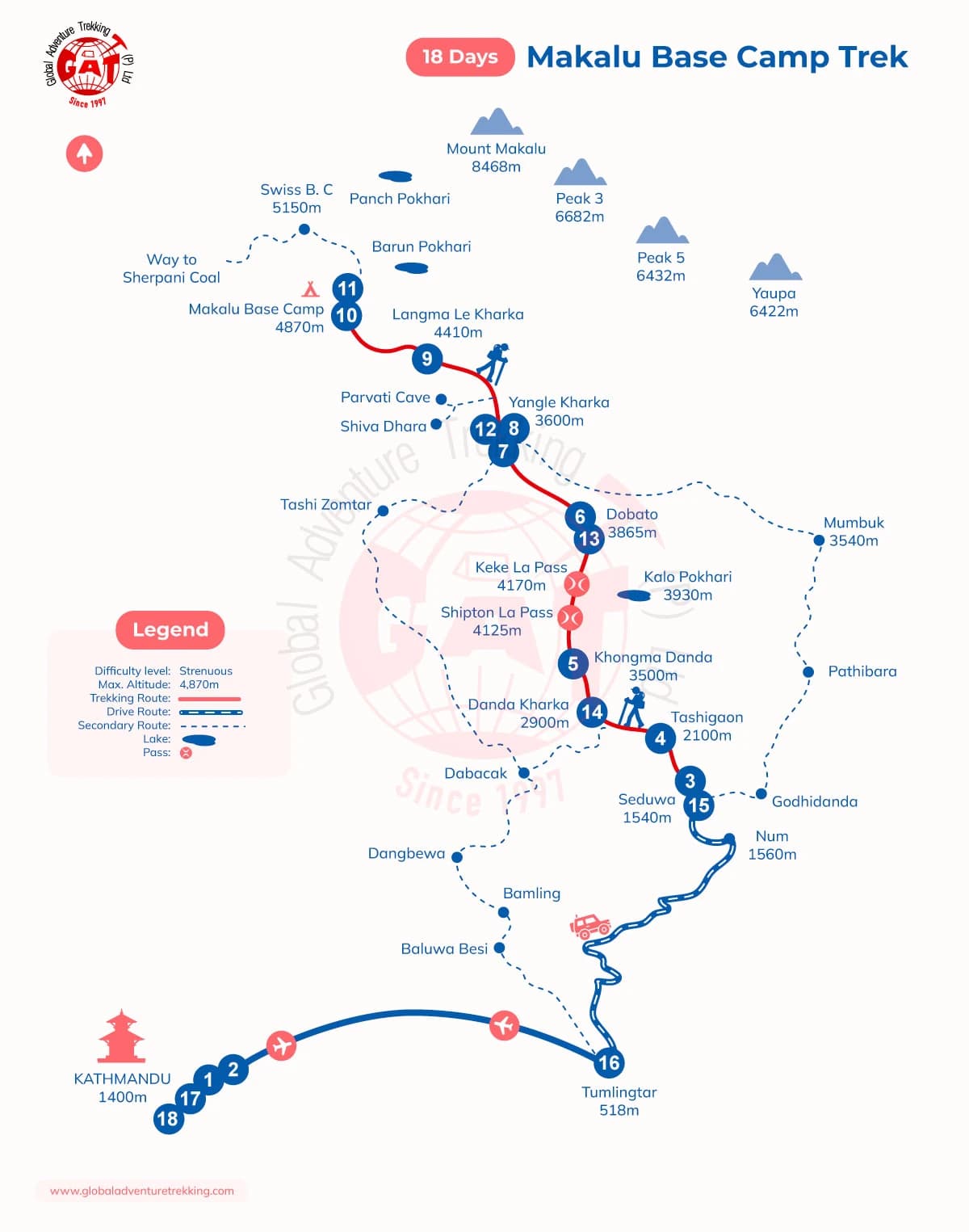
The Makalu Base Camp Trek route and map run east from Kathmandu, following a remote trail through Seduwa, Tashigaon, Khongma Danda, and the Barun Valley before reaching Makalu Base Camp at 4,870 meters. Along the way, the trail crosses high passes such as Shipton La (locally known as Tutu La Pass) at 4,125 meters and Keke La at 4,170 meters.
The route is demanding, with six- to eight-hour trekking days, steep and rocky terrain, suspension bridges, small streams, and genuine remoteness. These challenges make the Makalu Base Camp Trek more difficult, so previous high-altitude trekking experience is highly recommended for this remote area trekking journey.
The 18-day Makalu Base Camp Trek in Nepal begins with two days in Kathmandu, including a hotel transfer and a one-day sightseeing Kathmandu tour. You then fly to Tumlingtar Airport and drive to Seduwa, where the trek begins.
From Seduwa, the trail climbs through Tashigaon and Khongma Danda, crosses the Arun River, and continues into the spectacular Barun Valley. With acclimatization days along the route, you gradually reach Makalu Base Camp at 4,870 meters, with an optional hike to Makalu View Point at 5,700 meters. After reaching the heart of the Makalu region, you retrace the trail to Seduwa, drive to Tumlingtar, and fly back to Kathmandu.
The trek to Makalu Base Camp also offers a chance to experience the communities and traditions of eastern Nepal. Villages such as Chichila, Num, and Seduwa are closely connected with the Rai and Limbu communities, their traditional farming lifestyles, local haat bazaars, chauri, and animal husbandry.
Higher along the trail, Sherpa and Tibetan Buddhist influences become more visible through mantra-engraved prayer wheels, sacred mani walls, chortens, and colorful prayer flags. The local lifestyle and warm hospitality add an authentic cultural element to the journey, similar to the experience of the Kanchenjanga Base Camp Trek.
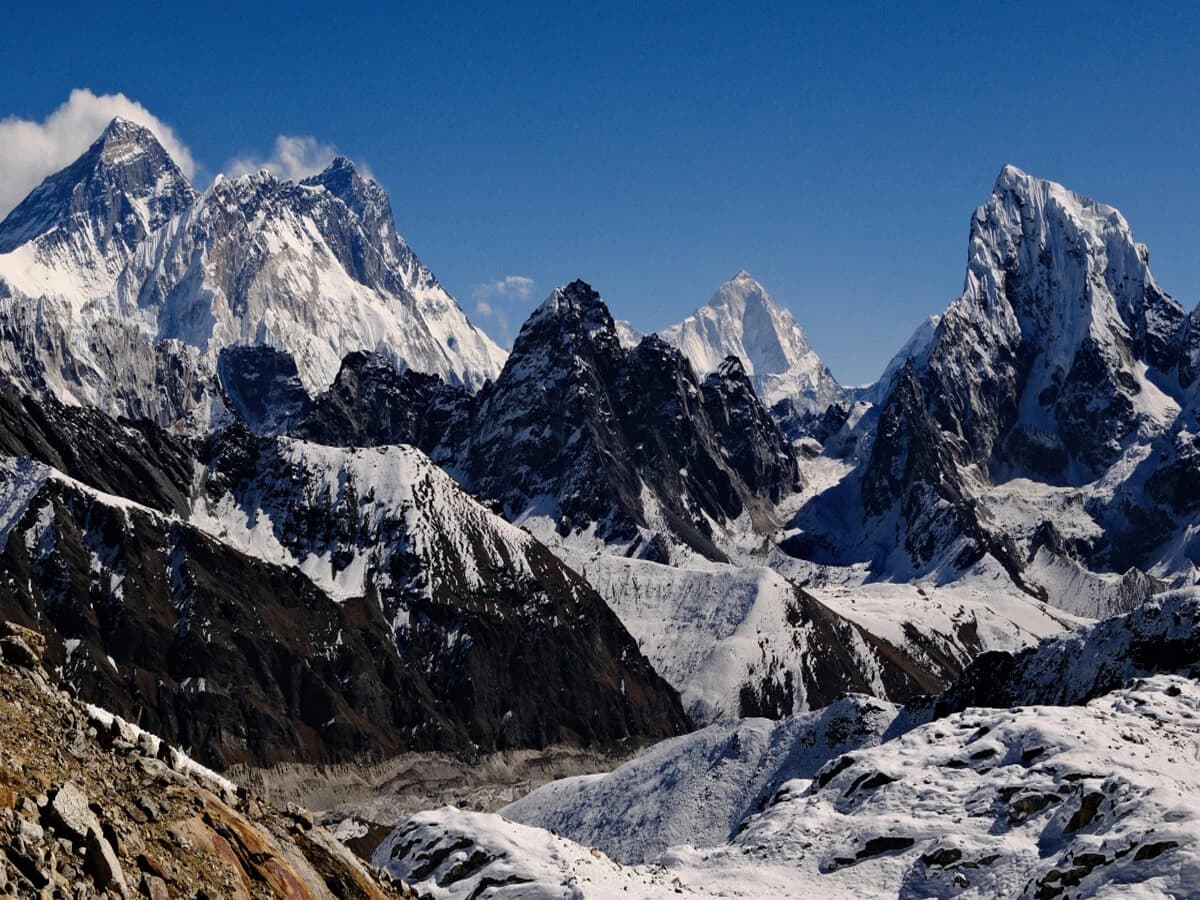
This Makalu Base Camp Trek Package is a long, strenuous trek suited to experienced trekkers and nature enthusiasts who prefer tranquil trails and pristine landscapes over busy routes. From base camp, views stretch toward the south face of Makalu, Barun Glacier, Everest, and Lhotse, while lower sections reveal green forests, pastures, rhododendron trees, charming villages, and the rich biodiversity of the national park.
This trek offers a chance to rejuvenate in the magic of magnificent landscapes and the authenticity of the Makalu Barun region. Start planning your 18-Day Makalu Base Camp Trek 2026 and 2027 and discover one of Nepal’s most remote Himalayan journeys with Global Adventure Trekking (GAT).
What Makes the Makalu Base Camp Trek Special?
- Makalu Base Camp (4,870 m), the ultimate destination beneath the world’s fifth-highest mountain.
- Makalu View Point (5,700 m) for astonishing Himalayan views.
- South face of Mount Makalu (8,485 m) and other nearby towering peaks.
- Makalu Barun National Park, known for its exceptional flora, fauna, biodiversity, and dramatic landscapes.
- Barun Valley and Barun Glacier, the most spectacular sections of this trek.
- Shipton La/Tutu La (4,125 m) and Keke La (4,170 m), challenging yet thrilling high passes on the route.
- Rhododendron, oak, and bamboo forests in the lower and middle elevations.
- Rai and Sherpa villages, along with ancient villages and local livelihoods.
- Tibetan Buddhist culture, with sacred mantra-engraved mani walls, prayer wheels, chortens, and prayer flags.
- Remote and less crowded trails, one of the most naturally drawn attractions on the trek.
- Wildlife and natural diversity, with opportunities to spot endangered mammal and bird species.
- Kathmandu sightseeing, including Pashupatinath Temple, Boudhanath Stupa, Swayambhunath Stupa, and Kathmandu Durbar Square.
- Scenic flight to Tumlingtar and changing landscapes on the drive to Seduwa.
Makalu Base Camp Trek Route and Map
The Makalu Base Camp Trek route stretches deep to the eastern part of Nepal, beginning with a flight from Kathmandu to Tumlingtar followed by a drive to Seduwa. From there, the trek route passes through Tashigaon and Khongma Danda before crossing the high passes of Shipton La and Keke La. The trail then enters the remote Barun Valley, passing through Dobate, Yangle Kharka, and Langmale Kharka before reaching Makalu Base Camp at 4,870 meters.
After spending time at base camp and exploring the high alpine landscapes, you repeat your route through Barun Valley and descend through the lower hills. The return journey passes through Dobate, Danda Kharka, and Seduwa before the road trip back to Tumlingtar and the flight back to Kathmandu.
Makalu Base Camp Trek Route
Kathmandu-Tumlingtar-Seduwa-Tashigaon-Khongma Danda-Dobate-Yangle Kharka-Langmale Kharka-Makalu Base Camp-Yangle Kharka-Dobate-Danda Kharka-Seduwa-Tumlingtar-Kathmandu
What Can You Expect on the Makalu Base Camp Trek?
Most of the travelers research the practical side of a trek, like cost, permits, duration of the trek, and how difficult it is. Fewer people stop to ask what the walking itself actually feels like. Here’s what the eighteen-day trek to MBC actually delivers:
From Green Hills to High Alpine Landscapes
Trekking into Makalu Base Camp takes you through an impressive change of scenery, beginning with terraced farmland, Rai villages, and warm green hills after the drive from Tumlingtar toward the trailhead. As you gain elevation, rhododendron, bamboo, pine forests, and open pastures replace the lower settlements, leading toward the high passes of Shipton La and Keke La.
Beyond the passes, the route enters the remote Barun Valley, where the setting becomes calm and more alpine, with rocky slopes, rushing rivers, hidden glaciers, and towering mountain walls. At Makalu Base Camp (4,870 m / 15,978 ft), the greenery of the lower hills feels far away, replaced by a stark high-mountain setting beneath Mount Makalu (8,485 m), with views of peaks such as Everest (8,848.86 m), Lhotse (8,516 m), Chamlang (7,321 m), and Baruntse (7,129 m) on clear days. The contrast between green middle hills and its remote alpine wilderness is one of the most memorable parts of the trek in Nepal.
A Remote Side of the Himalayas
Unlike other busier trekking routes of Nepal, the Makalu Base Camp Trek in Nepal offers a quieter experience where small settlements, forests, and mountain valleys unfold with very few trekkers around. Modern facilities become increasingly limited as you move deeper into the region, but that is part of its charm. There is more space to walk at your own pace, take in the mountains, and experience a side of the Himalayas that still feels wonderfully untouched.
Local Villages and Himalayan Culture
The route passes through communities shaped by Rai, Sherpa, and Limbu traditions, offering a glimpse into the everyday life of eastern Nepal. In the higher settlements, Buddhist influences become more noticeable through stone mani walls, prayer wheels, chortens, monasteries, and colorful prayer flags. Simple local lodges provide an opportunity to experience the warmth and hospitality of mountain communities along the way.
Rivers, Forests, Glaciers, and Wildlife
The natural scenery changes constantly as you follow sections of the Arun and Barun river valleys. Suspension bridges, hanging glaciers or waterfalls like Barun Glacier, open grazing grounds, dense forests of varieties of 25 species of rhododendrons and bamboo, and rocky high-altitude terrain all form part of the route. The trek also passes through Makalu-Barun National Park, where the wide range of habitats supports diverse Himalayan flora and wildlife. Trekkers might get a chance to see snow leopard, red panda, Himalayan thar, musk deer, and other endangered wild animals.
Mountain Views That Get Bigger Every Day
The mountains become increasingly prominent as you cross Shipton La and Keke La and enter the Barun Valley. Here, the south face of Mount Makalu (8,485 m) dominates the horizon, while clear weather can reveal Chamlang, Baruntse, Everest, Lhotse, and Kanchenjanga from different viewpoints along the route.
Simple Tea Houses and Changing Weather
Staycation rooms become increasingly basic as you move farther into the Makalu region. Expect simple tea houses or mountain lodges, basic rooms, shared facilities, and hearty meals rather than the more developed lodge experience found on popular trekking routes like the Annapurna Base Camp or Everest Base Camp. Weather can also change quickly with elevation. Lower sections may feel warm and humid, while higher areas can become cold, breezy, windy, and unpredictable, so being ready for changing conditions is important.
The Challenge of Going Remote
Makalu is not a trek where comfort comes easily. Longer walking days, steep ascents and descents, rocky sections, high passes, hanging bridges, and basic facilities test both stamina and patience. The challenge becomes more noticeable above 4,000 meters, where altitude, weather, and consecutive days of walking demand careful pacing and proper acclimatization.
The Feeling of Reaching Makalu Base Camp
Arriving at Makalu Base Camp at 4,870 m (15,978 ft) feels different because of everything that comes before it. After passing through villages, forests, high passes, and the Barun Valley, you finally stand beneath Makalu in a stark alpine setting surrounded by striking glaciers and towering peaks. The destination is memorable, but so is knowing how far you have traveled into hidden Himalayan regions to reach it.
Makalu Base Camp Trek - 18 Days Day-by-Day Itinerary
- Day 01: Arrival in Kathmandu and Transfer to Hotel (1,400 m/4,600 ft.): Approx. 35-40 min.
- Day 02: Kathmandu City Exploration and Trek Preparation: (1,400 m/4,600 ft.): Approx. 3-4 hrs
- Day 03: Fly from Kathmandu to Tumlingtar Airport (45 min) and Drive to Seduwa (1,540 m / 5,052 ft): Approx. 80-85 km (49.7-52.8 miles), 5-6 hrs
- Day 04: Trek from Seduwa to Tashigaon (2,100 m / 6,890 ft): Approx. 6-8 km (3.7-5 miles), 5-6 hrs
- Day 05: Trek from Tashigaon to Khongma Danda (3,500 m / 11,483 ft): Approx. 5-7 km (3.1-4.4 miles), 7-8 hrs
- Day 06: Trek from Khongma Danda to Dobate (3,865 m / 12,677 ft): Approx. 7-8 km (4.3-5 miles), 6-8 hrs
- Day 07: Trek from Dobate to Yangle Kharka (3,600 m / 11,811 ft): Approx. 8-9 km (5-5.6 miles), 6-7 hrs
- Day 08: Acclimatization Day at Yangle Kharka (3,600 m/11,811 ft.) with Optional Hike to Shiva Dhara (Approx. 4,310 m) and Parvati Cave (Approx. 4,500 m): Approx. 4-6 km (2.5-3.7 miles) round trip, 8-9 hrs
- Day 09: Trek from Yangle Kharka to Langmale Kharka (4,410 m/14,469 ft.): 7-8 km (4.3-5 miles), 5-6 hrs
- Day 10: Trek to Makalu Base Camp (4,870 m/15,978 ft.) 3-4 hrs and Side Trip to Swiss Camp, 2-4 hrs, 7-8 km (approx. 4.3-5 miles)
- Day 11: Acclimatization Day with Optional Hike to Makalu View Point (5,700 m/18,700 ft.): Approx. 8-9 hrs Round Trip
- Day 12: Trek from Makalu Base Camp to Yangle Kharka (3,600 m / 11,811 ft), 16-17 km (9.9-10.6 miles), 6-7 hrs
- Day 13: Trek from Yangle Kharka to Dobate (3,865 m / 12,677 ft), 7-9 km (4.3-5.6 miles), 5-6 hrs
- Day 14: Trek from Dobate to Danda Kharka (2,900 m / 9,514 ft), 12-13 km (7.5-8.1 mi), 7-8 hrs
- Day 15: Trek from Danda Kharka to Seduwa (1,540 m / 5,052 ft), 12-14 km (7.5-8.7 mi), 6-7 hrs
- Day 16: Drive from Seduwa to Tumlingtar (518 m / 1,699 ft): Approx. 65-70 km (40 to 44 miles), 5-6 hrs drive
- Day 17: Fly from Tumlingtar to Kathmandu: Flight Approx. 35-45 min
- Day 18: Final Departure from Kathmandu: 30 min Transfer to Tribhuvan International Airport (TIA)
Makalu Base Camp Trek - 18 Days Itinerary
Welcome to Nepal, After landing at Tribhuvan International Airport (TIA) in Kathmandu, you can see Global Adventure Trekking’s (GAT) representative holding a name plate and waiting for you. Once you meet our team members in the airport lounge, you'll be transferred by private vehicle to your 3-star hotel in Thamel, the lively heart of Kathmandu City.
After checking in and taking some time to rest, you can spend the evening at your own pace. Take a moment to walk through the vibrant streets of Thamel, explore its cafés and restaurants, listen to live music, or simply unwind at the hotel. Prepare for tomorrow's Kathmandu sightseeing tour.
Note: If you have any difficulty locating our representative upon arrival at the airport, please contact us via WhatsApp at +977 9841527688. We will be happy to assist you.
On the second day of your trip to Makalu Base Camp, enjoy a full day in the capital; you'll spend the morning touring Kathmandu's UNESCO-listed temples and squares.
They are:
- Swayambhunath Stupa (Monkey Temple): One of the oldest and most sacred sites, revered by both Hindus and Buddhists.
- Boudhhanath Stupa: One of the largest spherical stupas in the world, covered by Tibetan monasteries, shops, and rooftop cafes.
- Kathmandu Durbar Square: The historical and ancient Newari architectural hub, including Kumari Ghar (home of the living goddess Kumari)
- Pashupatinath Temple: The most sacred Hindu temple dedicated to the lord Shiva on the banks of the holy Bagmati River.
After travelling to the capital city, next is switching gears to logistics in the afternoon. This is when permits are finalized, kits are checked against the packing list, and any last-minute gear gaps get filled before heading into one of Nepal's most remote trekking regions.
Your third day’s journey into the remote Makalu region begins with a scenic 45-minute flight from Kathmandu Tribhuvan International Airport (TIA) to Tumlingtar Domestic Airport. After landing, you'll continue by shared jeep toward Khadbari (headquarters of the Sankhuwasabha District), 13 to 14 km from Tumlingtar Airport, passing through local markets and everyday scenes of eastern Nepal. Depending on the day, you may see a lively haat bazaar, vegetable and fruit stalls, local chickens for sale, and tempos waiting to carry people between nearby villages.
From Khadbari, the road continues to Num Bazaar, gradually leaving the busier settlements behind. The drive follows winding mountain roads before descending into the striking Arun River gorge. After crossing the river, the route climbs again to the Makalu Barun National Park, passing through Num before continuing to Seduwa at 1,540 meters (5,052 ft). This long travel day offers your first real taste of the changing landscapes, local life, and remoteness that define the Makalu Base Camp Trek.
Note: A private helicopter booking from Kathmandu to Tumlingtar can be arranged as an optional upgrade at an additional cost for greater flexibility. This can be a convenient alternative to the scheduled flight, subject to helicopter availability, weather, and operational conditions. Please let us know in advance if you would like to add this option to your Makalu Base Camp Trek.
Today, the first full-day trek starts on the Makalu trek itinerary and takes you from Seduwa to Tashigaon, gradually gaining elevation through the green hills of the Makalu region. The trail winds along narrow village lanes and stone staircase-style paths, passing small wooden bridges, flowing streams, Tibetan words carved on big stones, terraced farmland, a suspension bridge, and scattered houses surrounded by lush vegetation.
As you walk, you may hear local Tibetan-influenced words and conversations, “Tashi Delek,” adding to the cultural character of the route. The trail eventually reaches Chhekse Danda before continuing through forests and mountain settlements to Tashigaon, the last permanent village before the trail becomes increasingly remote.
The fifth day is one of the more demanding days of the Makalu Base Camp Trekking adventure, with a steady uphill climb from Tashigaon to Khongma Danda. Leaving the Sherpa village behind, the trail passes through Danda Kharka, green forests, local teahouses, open pastures, and colorful prayer flags fluttering along the route. You may see local animal husbandry along the way, including chauri, the yak-cow hybrid commonly kept by mountain families.
At Dhara, a natural water source and a popular resting point, you can pause for lunch and taste the chauri milk before continuing through rhododendron forests and across mountain teahouses. You can witness the process of making the local drink “Raksi,” made with locally grown millet and wheat by locals. In spring, the forests come alive with beautiful rhododendron blooms. The final ascent brings you to charming Khongma Sherpa village, a ridge circled by impressive views of Chamlang, Peak 6, and Makalu.
Day six is one of the most satisfying and challenging sections of the trek, with a series of uphill and downhill stretches across high mountain ridges. The day begins with an hour-long climb to Khongma View Point, where you can look across the Kanchenjanga range, Makalu, and neighboring snow-capped peaks.
The trail then continues to Shipton La Pass, followed by a descent to Kalo Pokhari, a small high-altitude lake where you can take a short break. From here, another steady climb leads to Keke La Pass before the trail descends through rugged stone pathways toward Dobate, a small settlement nestled in the valley.
The two demanding major passes offer serene, constantly changing terrain, sweeping mountain views, an isolated atmosphere, and sacred ponds, making the effort worthwhile. Stay in a local mountain teahouse in Dobate for tonight.
Today's Makalu trek trail descends from Dobate through pine and rhododendron forests, gradually bringing you to the Barun Valley on day 7. After around two hours of walking downhill, you'll reach the Barun River and continue along its riverside trail. The route passes through rugged, landslide-prone sections and rocky terrain, so take care around loose ground, especially during the monsoon.
Locally known as Yak Kharka, this area opens into a wilder landscape of cliffs, waterfalls, and high Himalayan areas. After lunch at Nhe Kharka, the trail follows the valley on a mostly gentle, undulating stretch before reaching Yangle Kharka, a peaceful riverside settlement at 3,600 meters where you'll spend the night.
Today is a much-needed acclimatization day at Yangle Kharka (3,600 m / 11,811 ft), giving your body enough time to adjust before the trail climbs higher toward Langmale Kharka and Makalu Base Camp. You can spend the whole day resting around the valley and Barun River or take the optional hike toward the sacred Shiva Dhara shrine and Parvati Cave (Parvati Gupha).
The optional hike of the MBC route begins with a slow walk before crossing the Barun River and climbing up to the cave area. The final section becomes more challenging, with uneven ground and narrow rope-assisted sections requiring careful footing and a steady pace.
Shiva Dhara is a place of religious importance for Hindu, Buddhist, and Kirat devotees. The site is associated with three main points: Shiva Cave, Parvati Cave, and Ganesh's abode. Inside Shiva Cave, a continuous stream of water emerges from the rock, creating a striking natural feature beneath the snow-capped Himalayan peaks. For pilgrims, the flowing water also carries deep spiritual meaning.
The optional excursion can take most of the day, so it should only be undertaken if your guide considers the trail conditions and your fitness suitable. If you prefer to rest, staying at Yangle Kharka is equally useful for acclimatization. Either way, the day prepares you for the higher and more demanding trail ahead.
Today’s trail step-by-step climbs deeper into the upper Barun Valley after leaving Yangle Kharka today. For the first 1.5 to 2 hours, the route passes through patches of forest with a mix of soft and gentle uphill and downhill sections before reaching Merak, a common stopping point for trekkers and a good place to have lunch.
Beyond Merak, the landscape begins to change noticeably as the trail climbs higher. Vegetation becomes thinner, and the route crosses rocky and landslide-prone sections, small streams, and open grazing areas. A steady uphill stretch of around 45 minutes leads toward Langmale Kharka, where the valley opens into a quieter alpine landscape with wide mountain views.
Langmale Kharka is traditionally used as a summer pasture for yak herds, so you may see yaks grazing across the nearer meadows. From here, the scenery becomes increasingly dominated by the high Himalayas, with views toward Peak 3, Peak 4, Peak 5, Chamlang, and Hongku Chuli.
Today involves a significant altitude gain of around 810 m (2,657 ft), so there is no need to rush. Walk at a comfortable speed, take regular breaks, and pay attention to how your body is responding as you move above 4,000 metres.
Today is the day you've been building toward as the trail leads from Langmale Kharka to Makalu Base Camp (MBC). The first hour climbs uphill before easing into a relatively level stretch toward Shershong. If time and trail conditions allow, you can take a short side trip to a nearby glacial lake before continuing. From Shershong, the trail crosses the open upper Barun Valley, passes over a small river, and eventually reaches Makalu Base Camp at 4,870 m (15,978 ft). The short distance may seem easy on paper, but the high altitude makes a steady pace and regular breaks important. You can witness glacial amphitheaters with Mount Makalu (8,485 m), Everest (8,848.86 m), Chamlang (7,321 m), Baruntse (7,129 m), and Kanchenjanga (8,586 m).
After lunch at base camp, take some time to rest and enjoy the gorgeous surroundings beneath the south face of Makalu. If you're feeling strong and conditions are suitable, you can make an optional 2-4-hour side hike toward Swiss Camp for wider views of Makalu, Peak 6, Peak 7, Everest, and Lhotse, along with the closer glaciers and high Himalayan valleys. Your guide will help determine whether the extra hike is suitable for you based on your energy, weather, and trail conditions.
Today is another important acclimatization day at Makalu Base Camp, with an optional challenging hike to Makalu View Point at 5,700 m (18,700 ft). The trail turns uphill onto rocky terrain and climbs steadily toward the viewpoint from base camp. The hike is difficult because of the altitude and uneven ground, so it should only be attempted if you are feeling well and your guide considers the conditions suitable. Take your time, stay hydrated, and enjoy regular breaks along the way.
Reaching the viewpoint around midday gives you a remarkable perspective of the rugged Himalayas. From this high ridge, you can look across Makalu, Everest, Lhotse, Chomo Lonzo, Baruntse, Chamlang, Kangchungtse (Makalu II), Peak 6, and Peak 7, with glaciers and towering mountain valleys stretching below. After taking in the views, you'll return to Makalu Base Camp and spend another night at altitude, allowing your body to adjust before beginning the descent.
After breakfast, you'll begin retracing your steps from Makalu Base Camp toward Langmale Kharka on day twelve, this time following the trail downhill. The route walks through the upper Barun Valley, with a mix of rocky sections, gradual stretches, and steeper descents. By around midday, you'll reach Langmale Kharka, where you can stop for lunch and rest before continuing. The landscape slowly becomes greener, with juniper and rhododendron vegetation appearing along the trail as you lose elevation.
The trail continues downhill for around two hours, with a mix of gentle sections and what locals often call a “Nepali flat,” before reaching the wider valley around Yangle Kharka after Langmale Kharka. You may spot birds and grazing yaks and chauris along the way, while the Barun River once again becomes a familiar companion as you approach the riverside settlement. After the long descent from 4,870 m, Yangle Kharka at 3,600 m offers a more relaxed setting for your overnight stay at Yangle Kharka teahouse.
The morning begins with a short level walk from Yangle Kharka before a 1.5-hour descent along stone pathways toward Nhe Kharka. From there, the route passes through a landslide-prone section and follows the Barun River through a more wooded part of the valley. Rhododendron, juniper, and fir become more prominent as the vegetation thickens, while occasional openings offer views of Makalu, Chamlang, and other Himalayan peaks. The tranquil surroundings and seasonal grazing areas make this a pleasant stretch before the harder part of the day.
The Makalu Base Camp Trek Short Itinerary route turns sharply uphill for the final push to Dobate after leaving the riverbank. The ascent takes more than two hours and winds through dense forest, making this section considerably more strenuous than the earlier walk. Take your time on the climb and save some energy for the final stretch. Once you arrive at Dobate, settle into the basic mountain teahouse accommodation and enjoy a well-earned rest before tackling the high passes on the following day.
After breakfast in your teahouse, you'll leave Dobate for another demanding day in the mountains, beginning with around two hours of uphill walking toward Keke La Pass. From the pass, the route drops for roughly 30 minutes toward Kalo Pokhari before rising again toward Shipton La. As you cross familiar high points in reverse, the changing terrain gives you a final taste of the alpine section before the descent begins.
From the pass area, the route winds downhill for around two to three hours toward Khongma View Point and Khongma Danda, where you can stop for a late lunch and take in the mountain scenery. The final stretch heads through greener vegetation toward Danda Kharka, with the foliage becoming denser as you lose elevation. After a long day of ascents and descents, Danda Kharka at 2,900 m (9,514 ft) provides a quieter place to spend the night and recover for the final stages of the trek.
Today marks a major change in the scenery as you leave Danda Kharka and make your way toward the lower hills. The first part of the morning involves a two–three-hour descent to Tashigaon, passing through forested slopes and quieter mountain settlements along the way. After reaching Tashigaon, you can stop for lunch and take some time to recover before setting off again. The route then drops further through Sherpa, Rai, and Gurung communities, with terraced farmland, small gompas, and patches of rhododendron and bamboo adding character to the journey.
The afternoon walk continues downhill toward Seduwa, bringing you back into a warmer and more settled part of the Makalu region. After several days among high alpine valleys and rugged mountain terrain, the return to village life feels noticeably different. By evening, you'll arrive at Seduwa at 1,540 m (5,052 ft), where you can lay down and enjoy a well-earned rest before the drive toward Tumlingtar the following day.
You'll leave Seduwa by private vehicle (shared jeep) and head toward Tumlingtar, with around 5 to 6 hours on the road journey after breakfast. The first part of the drive follows winding, mostly unpaved mountain roads through villages and hillside settlements. Glimpses of the Arun and Sabha valleys appear between the bends as you descend toward the lower valleys; the road becomes smoother and the landscape more settled.
The road becomes smoother as you approach the lower hills and Khandbari, making the final part of the drive more comfortable. You arrive in Tumlingtar, a warmer and more settled part of eastern Nepal. Spend the evening resting at the hotel and preparing for tomorrow's short flight to Kathmandu.
On your 17-day of Makalu Base Camp Trek, you'll head to Tumlingtar Airport for your picturesque flight back to Kathmandu. Flights are generally scheduled in the morning, often around 10:00 AM, although the exact departure time can vary depending on the airline and operating conditions. The approximately 35 to 45-minute flight gives you one last aerial perspective of eastern Nepal, with views of the Arun River valley, nearby hills, and Himalayan peaks along the way.
As the aircraft leaves the eastern hills behind, the scenery gradually changes from remote mountain terrain to the more populated Kathmandu Valley. On arrival, you'll be transferred to your hotel and have free time to rest, explore the city, or enjoy some well-earned downtime and enjoy a farewell dinner after your trek. You can add an extra Nepal journey toward the Luxury Chitwan National Park Tour for a different experience from the Himalayas to wildlife if you wish to extend more days in the land of Nepal.
On your departure day from the mesmerizing Makalu trek adventure, our GAT representative will pick you up from your hotel after breakfast, or around three hours before your scheduled flight. Leaving with enough time allows you to account for Kathmandu traffic and complete airport formalities, including security checks, baggage drop-off, and immigration.
With hundreds of photos, videos, and memories from the Himalayas, you'll say farewell to Nepal and head to the airport for your onward journey. We hope the experience stays with you long after you leave and that the mountains bring you back to Nepal for another adventure with the Global Adventure Trekking (GAT) team.
Makalu Base Camp Trek - 18 Days Cost Details
Check Availability for the Makalu Base Camp Trek 2026/ 2027
The 18-day Makalu Base Camp Trek package covers airport pickup and drop-off, 3-star category hotel accommodation in Kathmandu on a bed-and-breakfast basis, the Kathmandu-Tumlingtar-Kathmandu flights, ground transport between Tumlingtar and Seduwa, a licensed English-speaking guide, all necessary permits, and full-board meals throughout the trekking days.
What's not included is your Nepal entry visa, international airfare, travel insurance, porter service, and personal costs on the trail such as bottled or boiled water, device charging, and hot showers at the higher camps, all of which are worth budgeting for separately given how limited these amenities become above Tashigaon.
Includes
Transportation
- Airport pick-up and drop-off in Kathmandu by private vehicle.
- Pick-up and drop-off for the Kathmandu city tour by private vehicle.
- Kathmandu to Tumlingtar and Tumlingtar to Kathmandu domestic flight tickets, including applicable departure taxes.
- Shared jeep transportation from Tumlingtar to the trekking starting point and back to Tumlingtar as mentioned in the itinerary.
- All required ground transportation.
Accommodation
Kathmandu:
- 3 Nights Accommodation in a comfortable 3-star category hotel on a bed-and-breakfast (BB) plan.
- Twin-sharing room unless otherwise requested.
During the Trek:
- 14 Nights of Accommodation in the best available local teahouses and mountain lodges along the Makalu route.
- Twin-sharing rooms with basic bedding and shared bathroom facilities where available.
Meals
- Daily breakfast during your stay in Kathmandu.
- Full-board meals during the trek, including breakfast, lunch, and dinner.
- Freshly prepared local and trekking-friendly meals along the route.
Trekking Permits and Fees
- Makalu-Barun National Park Entry Permit.
- TIMS (Trekkers' Information Management System) Card.
- Applicable local government or rural municipality fees.
- Required permit processing and administrative charges.
Professional Trekking Team
- Experienced, government-licensed, English-speaking mountain trekking guide.
- Guide’s salaries, meals, accommodation, transportation, and insurance.
- Necessary trekking equipment and clothing for the guide as required for the trek.
Safety and Support
- Comprehensive first-aid and medical kit carried by the trekking team.
- Guide and porter insurance.
- Assistance and coordination in case of an emergency during the trek.
- Support from the Global Adventure Trekking team throughout the trip.
Taxes and Service Charges
- Applicable government taxes.
- Local government taxes and administrative charges.
- Company service charges.
Excludes
Travel Documents
Nepal tourist visa fee, which can be obtained on arrival at Tribhuvan International Airport in Kathmandu.
- USD 30 for 15 days
- USD 50 for 30 days
- USD 125 for 90 days
International and Additional Flights
- International airfare to and from Kathmandu.
- Any additional domestic flights or helicopter services not mentioned in the itinerary.
- Private helicopter or charter services are requested as an optional upgrade.
Accommodation and Meals
- Lunch and dinner in Kathmandu.
- Extra nights in Kathmandu due to early arrival, late departure, flight delays, early return from the trek, or other circumstances outside the scheduled itinerary.
- Additional accommodation or meals resulting from itinerary changes not included in the package.
Personal Expenses
- Travel insurance and emergency medical expenses.
- Helicopter rescue or evacuation costs.
- Personal expenses such as telephone calls, laundry, Wi-Fi, hot showers, battery charging, snacks, soft drinks, alcoholic beverages, and souvenirs.
- Bottled or boiled drinking water and personal water treatment supplies.
- Personal trekking equipment and clothing.
- Excess baggage charges for luggage exceeding the applicable domestic airline limit.
- Tips and gratuities for your guide, porters, drivers, and other supporting staff. Tipping is customary in Nepal and is appreciated for good service.
Porter Service
- Porter service at the standard ratio of 1 porter for every 2 trekkers with around a 20-22 kg weight limit.
Other Services
- Any service, activity, transportation, meal, accommodation, or expense not specifically mentioned in the “Includes” section.
Add-ons & Options
You can customize your Makalu Base Camp Trek with a few optional services before or during the journey. These add-ons are useful if you want more comfort in Kathmandu, less weight on the trail, or a faster return from the mountains.
Hotel Upgrade in Kathmandu:
Upgrade your standard Kathmandu accommodation to a 4-star luxury hotel or higher luxury category for a more comfortable stay before and after the trek. This option is suitable for travelers who prefer upgraded rooms, for honeymoon suite bookings, for additional hotel facilities, for a little more comfort around trekking days, or for many other personal interests.
Porter Service:
A porter service can be added if you prefer a trek with lighter-weight baggage on your back. Your porter carries your main trekking luggage while you keep only essentials needed during the day’s walk. This can make the long days on foot and steep sections of the Makalu route more manageable.
Helicopter Transfer:
The helicopter transfer is a great alternative for the domestic flight options and byroad travel. It can be arranged for travelers who want to reduce the road and trekking time at the beginning or end of the journey, subject to weather, flight conditions, availability, seasons, and the applicable route. Helicopter flight service can also be coordinated for emergency evacuations when medically necessary.
These add-ons can be arranged by Global Adventure Trekking (GAT) according to your preferences and availability. Let our team know what you need when planning your trek, and we can help arrange the right options for a more comfortable and flexible Makalu Base Camp experience. Customize Makalu Base Camp Trek!
Dates & Availability
Select your preferred date
Global Adventure Trekking specializes in organizing treks for individuals, couples, families, and small groups. You can enjoy your trek as a private group on your preferrd date, without paying any additional cost. Feel free to contact us to inquire about possible dates for group treks that you might be able to join.
Essential Information
Makalu Base Camp Trek Cost
The Makalu Base Camp Trek cost depends on the group size. The cost covers the services and arrangements included in the 18-day trek to Makalu. The final price may vary if you choose additional services or customize transportation, accommodation, or other arrangements.
Makalu Base Camp Trek Cost: 2026 and 2027
| Group Size | Cost Per Person |
|
1 person |
USD 2,409 |
|
2-5 pax. |
USD 1,956 |
|
6-12 pax. |
USD 1,830 |
How Much Extra Money Should You Carry for the Makalu Base Camp Trek?
We recommend carrying around NPR 2,500 to 3,000 or higher for each trekking day, which would be enough for extra expenses during the Makalu Base Camp Trek, or higher depending on your spending habits. This amount can cover personal expenses such as snacks, drinks, hot showers, energy bars, device charging, tips, souvenirs, Wi-Fi, and other small purchases along the trail. If you prefer more comfort or tend to spend more while traveling, carrying some additional cash is a good idea.
Private vs. Group Trek: Which Is Better For Makalu Base Camp?
- Private Trek: For a more flexible itinerary, personal attention from the guide, easier adjustment of walking pace, and better suited to trekkers with specific preferences.
- Group Trek: For a more social, generally more economical option, and a good choice for travelers who enjoy sharing the experience with other trekkers.
- For Makalu Base Camp Specifically: Because the route is remote and demanding, a private trek can offer more flexibility if weather, fitness, or acclimatization requires changes. A group trek is still a good option for those comfortable following a planned itinerary.
Plan My Private Makalu Base Camp Trek!
Helicopter Options for Nepal Makalu Base Camp Trek
Kathmandu to Tumlingtar by private helicopter: An alternative to the scheduled domestic flight, followed by the regular drive to Seduwa.
Tumlingtar to Kathmandu by private helicopter: A convenient option after completing the trek, avoiding the scheduled domestic flight.
Emergency helicopter evacuation: Available when medically necessary and subject to weather, helicopter availability, insurance coverage, and local operating conditions.
Private charter arrangements: Suitable for travelers who want a more flexible transport schedule.
Note: All above mention helicopter options are subject to availability and at an additional cost. WhatsApp Us at +977 9841527688 for the Consultaion
Makalu Base Camp Trek Permits: 2026/27 Updated
The Makalu Base Camp Trek requires a Makalu-Barun National Park Entry Permit, a TIMS Card, and the applicable local rural municipality fee. Since the trek enters Makalu-Barun National Park and follows designated trekking routes in Sankhuwasabha, these permits and fees are arranged before and during the trek as required by the relevant authorities.
The Nepal Tourism Board (NTB) lists the Makalu Base Camp Trek among the routes that require trekkers to be accompanied by a licensed trekking guide and to carry a TIMS Card issued through a government-registered trekking agency in Nepal.
Makalu-Barun National Park Entry Fee
|
Nationality |
Entry Fee |
|
Nepali Citizens |
NPR 100 |
|
SAARC Nationals |
NPR 1,500 |
|
Foreign Nationals |
NPR 3,000 |
|
Children below 10 years |
Free |
TIMS Card
A Trekkers' Information Management System (TIMS) Card is required for the Makalu Base Camp Trek, and trekkers must travel with a licensed trekking guide and carry a trekking agency-issued TIMS Card. The cost of a TIMS card is NPR 1,000 for SAARC national citizens and NPR 2,000 for other international trekkers.
Local Rural Municipality Fee
Depending on the route, local administrative fees may also apply in Sankhuwasabha. The fee published by the Nepal Tourism Board (NTB) and the Trekking Agencies' Association of Nepal (TAAN) for Bhotkhola Rural Municipality and Makalu Rural Municipality, Ward No. 4, is USD 20 per person per week for the first four weeks, increasing to USD 25 per week thereafter.
Documentary and Filming Permit
If you plan to film a documentary, commercial production, or any other permitted filming project inside Makalu-Barun National Park, a separate permit from the Department of National Parks and Wildlife Conservation (DNPWC) is required. The applicable filming fees stated by DNPWC:
|
Applicant |
Documentary/Filming Fee |
|
Nepali Nationals |
NPR 10,000 |
|
SAARC Nationals |
NPR 50,000 |
|
Foreign Nationals |
USD 1,500 |
For Drone Use: An additional 25% of the applicable documentary/filming fee is charged when a drone is used for documentary or filming purposes. Drone use for other purposes is subject to the applicable DNPWC rules and fees, so trekkers should obtain the required approval before flying a drone inside the park.
Note: All the necessary permits for the 18-day Makalu Base Camp Trek are arranged by Global Adventure Trekking (GAT) and included in this package cost. Regular trekkers do not need a documentary or filming permit simply to take personal photographs. However, if you intend to use professional filming equipment or a drone for a production, consult with GAT before your trek.
Solo Trekking and Guide Requirements
The Makalu Base Camp Trek requires trekkers to travel with a licensed trekking guide arranged through a registered trekking agency. While Nepal's updated 2026 trekking rules have made solo travel possible in some areas, this does not mean you can trek the Makalu route completely unguided. GAT can arrange the required guide, permits, TIMS, and other documentation before departure.
Rules and Regulations for the Makalu Base Camp Trek
The Makalu Base Camp Trek passes through Makalu-Barun National Park, a protected area known for its rich biodiversity and remote and untouched mountain environment. Trekkers are expected to follow park regulations and practice responsible trekking throughout the journey.
Important Rules to Follow
Carry your permits: Keep your valid park entry permit and required trekking documents with you. Entering the national park without the required permit is not permitted.
Follow your guide's instructions: Stay with your trekking team and always follow your guide's advice, particularly on difficult sections, changing weather, and high-altitude days. The Nepal Tourism Board (NTB) requires a licensed guide and agency-issued TIMS for applicable protected trekking routes.
Protect the natural environment: Do not remove plants, flowers, rocks, or other natural resources, and never disturb wildlife. Makalu-Barun National Park protects a wide range of Himalayan flora and fauna.
Take your waste with you: Avoid littering and carry non-biodegradable waste such as batteries, plastic, and bottles out of the trekking area. Follow the park's waste-disposal instructions.
Respect local culture: Treat monasteries, chortens, mani walls, prayer wheels, temples, and other cultural or religious places with respect.
Do not trek after dark: The park's published regulations advise against walking inside the park between sunset and sunrise.
Use drones only with required authorization: Do not fly a drone simply because you have brought one on the trek. Drone use in the national park is subject to additional authorization and applicable aviation and park regulations.
Follow safety and altitude advice: Do not ignore symptoms of altitude sickness or continue ascending when your guide advises you to stop or descend. The Makalu-Barun Park guidance also warns that mountain sickness can become serious when elevation is gained too quickly.
Responsible trekking matters in Makalu because the route passes through fragile mountain ecosystems and communities that depend on the area. A simple rule to remember is to take only photographs, leave only footprints, and respect the people and places you encounter.
Best Time for the Makalu Base Camp Trek
The best time for the Makalu Base Camp Trek is generally during spring (March to May) in Nepali Chaitra and Baisakh and autumn (September to November) in Bhadra, Ashwin, and Kartik, according to the Nepali calendar. These seasons offer more stable weather, clearer mountain views, and better trail conditions. Summer coincides with the monsoon, while winter brings freezing temperatures and heavy snowfall at higher elevations.
| Season | Months | Lower Elevations | Higher Elevations | Trekking Conditions | Recommendation |
| Spring | March to May | 10℃ to 27℃ | -5℃ to 12℃ |
Mild weather, clear mountain views, blooming rhododendron forests, improving trail conditions |
Excellent |
| Summer/Monsoon | June to Augus | 20℃ to 30℃ | 5℃ to 12℃ |
Continuous rain, muddy and slippery trails, leeches, poor visibility, landslide possibilities |
Best to Avoid |
|
Autumn |
September to November | 10℃ to 27℃ | -5℃ to 10℃ |
Stable weather, clear skies, good visibility, comfortable trekking conditions |
Best Time |
| Winter |
December to February |
3℃ to 15℃ | -15℃ to 0℃ |
Freezing temperatures, heavy snowfall at higher-elevation areas, and high passes may make it difficult or impassable. |
Not recommended |
Note: Temperatures are approximate and can vary significantly with altitude, weather, time of day, and location along the route. Conditions at Makalu Base Camp and the high passes are considerably colder than at lower elevations.
How Difficult Is the Makalu Base Camp Trek?
One of the demanding and strenuous trekking destinations is the Makalu Base Camp Trek, best suited to trekkers with good physical fitness, stamina, and some previous high-altitude trekking experience. The route is more challenging than popular treks such as the Everest Base Camp and Annapurna Base Camp treks because of its remote setting, steep ascents and descents, high passes, and long trekking days. Most days involve around 6 to 8 hours of walking, with multiple sections above 4,000 meters.
The highest point of the trek is Makalu Base Camp at 4,870 m (15,978 ft), with the optional Makalu View Point reaching approximately 5,700 m (18,700 ft). The crossing of Shipton La and Keke La adds further physical challenge, while rocky paths, uneven terrain, and changing weather require careful walking and patience. To handle the altitude and challenging terrain, trekkers need proper acclimatization, regular hydration, a comfortable walking pace, and adequate preparation.
What Makes the Makalu Base Camp Trek Difficult?
| Makalu Base Camp Trek Difficulty Factor | What to Expect on the Makalu Base Camp |
| Altitude | The trek reaches 4,870 meters at Makalu Base Camp, with an optional hike to around 5,700 meters. |
| High Passes | Shipton La and Keke La passes involve steep ascents and descents at high elevations. |
| Daily Walking | Most average trekking days involve approximately six to eight hours of walking. |
| Terrain | Expect pebble and stony paths, steep sections, uneven ground, forest terrain, and remote mountain trails. |
| Remoteness | Facilities are comparatively more basic than other popular trekking areas, so trekkers need to be comfortable with basic mountain conditions. |
| Weather | Weather patterns can change quickly at higher elevations, especially around passes and upper Barun Valley. |
| Experience | Past high-altitude trekking experience is recommended, though well-prepared and physically fit individuals can undertake the route with proper guidance. |
| Fitness | Good cardiovascular fitness, leg strength, stamina, and preparation for consecutive days of trekking are important. |
Is Makalu Base Camp Trek Suitable for Beginners?
The Makalu Base Camp Trek is not the easiest choice for first-time trekkers. Its distant setting, high-altitude passes, back-to-back long walking days, and altitude above 4,000 meters make it considerably more demanding than many popular trekking routes in Nepal. Prior experience with multi-day hikes is highly recommended, most importantly if you have not spent much time at higher elevations.
That does not mean being a beginner automatically rules you out. If you are in good shape, regularly hike or walk long distances, and prepare properly before departure, you may be able to take on the route with an experienced guide and a well-planned acclimatization schedule. For someone completely new to trekking, however, starting with a shorter and lower-altitude route would be a more comfortable introduction to the Himalayas.
Who Will Enjoy the Makalu Base Camp Trek Most?
Best suited for:
- Experienced high-altitude trekkers
- Physically fit hikers looking for a demanding Himalayan route
- Trekkers who prefer untouched, remote, and less-crowded trails
- Nature and wildlife enthusiasts
- Adventurous travelers comfortable with basic teahouse facilities
Who should avoid the Makalu Base Camp Trek:
- Complete beginners without multi-day trekking experience
- Travelers uncomfortable with lengthy walking days
- Those who struggle with steep ascents and descents
- Travelers looking for luxury accommodation or easy access
- Anyone unprepared for high-altitude conditions
Makalu Base Camp Trek vs. Kanchenjanga Base Camp Trek
| Factors | Makalu Base Camp Trek | Kanchenjanga Base Camp Trek |
| Typical Duration | 18 Days | 22 Days |
| Highest Point | 4,870 m at Makalu Base Camp: Optional view points around 5,700 m | 5,143 m at Pang Pema (North Base Camp) |
| Access from Kathmandu | Flight to Tumlingtar, followed by road travel to the trailhead | Flight to Bhadrapur, followed by a long road journey toward the trailhead |
| Protected Area | Makalu-Barun National Park | Kanchenjanga Conservation Area |
| Trekking Character | Remote valleys, high passes, raw and untouched landscapes, forests, glaciers, and mesmerizing Makalu views | Remote mountain valleys, glaciers, high passes, and stunning views of Kanchenjanga |
| Notable High Points | Shipton La and Keke La | Mirgin La and other high passes depending on the route |
| Daily Walking | Generally 6-8 hours | Generally 5-9 hours |
| Difficulty | Strenuous, with steep terrain, high passes, and remote sections. | Strenuous with long days, altitude, and remote terrain. |
| Best Season | March to May and September to November | March to May and September to November |
| Crowds | Quiet and less traveled | Very quiet and among Nepal’s less-visited trekking regions |
| Best Suited For | Trekkers seeking a challenging route through the Barun Valley and to Makalu Base Camp | Trekkers looking for an even more remote Himalayan experience centered around Kanchenjanga. |
Both treks offer remoteness and very raw and natural landscapes, but the right choice always depends on whether you want to stand beneath the Makalu in the Barun Valley or explore the rugged landscapes surrounding Kanchenjanga. View the Kanchenjanga Base Camp Trek.
Makalu Base Camp Trek Distance and Walking Hours
The Makalu Base Camp Trek takes you from the lower hills of eastern Nepal to Makalu Base Camp at 4,870 m (15,978 ft). The steady rise in altitude is one of the main challenges of the trek, which is why the itinerary includes rest days before entering the highest sections.
| Trek Places | Makalu Base Camp Trek Altitude/Approx. Feet | Approx. Distance | Trekking/Driving Time |
| Tumlingtar | 518 meters/1,699 feet | 185-186 km (air distance) | 45 min. flight from Kathmandu |
| Seduwa | 1,540 meters/5,052 feet | 80-85 km (by road) | 5-6 hour drive and trek from Tumlingtar |
| Tashigaon | 2,100 meters/6,890 feet | 6-8 km | 5-6 hour trek |
| Khongma Danda | 3,500 meters/11,483 feet | 5-7 km | 7-8 hour trek |
| Dobate | 3,865 meters/12,677 feet | 7-8 km | 6-8 hour trek |
| Yangle Kharka | 3,600 meters/11,811 feet | 8-9 km | 6-7 hour trek |
| Langmale Kharka | 4,410 meters/14,469 feet | 7-8 km | 5-6 hour trek |
| Makalu Base Camp | 4,870 meters/15,978 feet | 7-8 km | 3-4 hour trek |
| Makalu View Point | 5,700 meters/18,700 feet | 8-9 km | 8-9 hour round trip |
Why Is Acclimatization Important on the Makalu Trek?
As you move higher, the air contains less available oxygen, so your body needs time to adapt to those situations. This is why the Makalu Base Camp Trek does not simply increase altitude day after day without breaks. Spending additional time at selected elevations helps you adjust before moving farther into the upper Barun Valley.
Your GAT guide will monitor your condition throughout the trek, but you should also pay attention to symptoms such as headache, dizziness, unusual tiredness, nausea, or difficulty sleeping. If you feel unwell at altitude, tell your guide rather than trying to push through it. In some situations, descending to a lower elevation is the safest response.
Two acclimatization days are included in this trek. One is at Yangle Kharka (3,600 m), with an optional hike toward Shiva Dhara and Parvati Cave. The second is at Makalu Base Camp (4,870 m), where you can take an optional hike to Makalu View Point if conditions and your fitness allow.
Above 4,000 m, walk slowly, stay hydrated, eat regular and energy-rich meals, and tell your guide about any unusual symptoms. Proper preparation and allowing your body time to adjust are important parts of a safe Makalu Base Camp Trek.
Altitude Sickness: AMS, HAPE, and HACE
Altitude sickness is one of the main concerns on any trekking route that rises above 4,000 meters, including the Makalu Base Camp at 4,870 m (15,978 ft). Proper acclimatization, a steady walking pace, adequate hydration, and listening to your body are important throughout the high-altitude sections.
Mild symptoms of acute mountain sickness (AMS) can include headache, dizziness, nausea, tiredness, and loss of appetite. More serious conditions, including high-altitude pulmonary edema (HAPE) and high-altitude cerebral edema (HACE), are less common but can become life-threatening without immediate treatment.
Warning signs include:
HAPE: unusual breathlessness while resting, persistent cough, chest tightness, or bluish lips or fingernails.
HACE: severe headache, confusion, extreme drowsiness, loss of coordination, or difficulty walking normally.
Important Note:
- If serious symptoms appear, do not continue ascending. Inform your guide immediately and descend to a lower elevation as soon as possible. Supplemental oxygen or an emergency evacuation may be required depending on the condition. Your trekking guide will monitor your health and help coordinate emergency assistance when necessary.
- For medication such as acetazolamide (Diamox), consult a qualified medical professional before the trek rather than self-medicating.
How to Prepare for the Altitude?
You do not need to train for altitude itself, but you should arrive with enough fitness to handle several consecutive days of walking. Regular hiking, uphill walking, cardio exercise, and leg-strengthening workouts can help build the endurance needed for the route. During the trek, keep your walking speed in a comfortable way, stay hydrated, avoid rushing, avoid smoking and alcohol, and give your body time to adjust to each increase in elevation.
How Much Do You Walk?
The trekking section covers approximately 100 to 110 km (62 to 68 miles), depending on the exact route and optional hikes. Daily walking generally takes around 6 to 8 hours, with some shorter and more demanding days. The trail includes steep ascents, stony sections, high passes, forest paths, and uneven terrain, so both distance and elevation gain matter when preparing for the trek.
Travel Insurance Requirement for the Makalu Base Camp Trek
Travel insurance is an important part of preparing for the Makalu Base Camp Trek. The route reaches 4,870 m (15,978 ft) at Makalu Base Camp, with the optional Makalu View Point reaching around 5,700 m (18,700 ft). The remote nature of the trek also means that medical facilities and road access are limited in the higher sections.
Before traveling to Nepal, make sure your insurance requirement policy specifically covers high-altitude trekking at the maximum elevation of your planned itinerary. If you intend to hike the optional Makalu View Point, check into your policy, which also covers trekking to that elevation.
What Should Your Insurance Cover?
A comprehensive policy for the Makalu trek should ideally include:
- High-altitude trekking: Coverage for trekking at the maximum elevation you plan to reach.
- Emergency medical treatment: Medical expenses, hospitalization, and treatment required during the trek.
- Helicopter evacuation: Emergency air evacuation from remote areas, subject to your insurer's terms and emergency procedures.
- Trip cancellation or interruption: Protection if you need to cancel or cut your trip short because of a covered reason.
- Flight disruption: Coverage for eligible delays, cancellations, or missed connections, particularly because the itinerary involves domestic flights to and from Tumlingtar.
- Repatriation: Assistance and transportation home if medically necessary under the terms of your policy.
- Baggage and personal belongings: Coverage for eligible loss, theft, or damage.
Check the Policy Before You Trek
Do not assume that a standard travel insurance policy automatically covers high-altitude trekking or helicopter rescue. Read the exclusions carefully and confirm the maximum altitude, trekking activities covered, medical evacuation conditions, and whether you need to pay costs upfront before seeking reimbursement. Keep your policy number, insurer's emergency contact details, and relevant documentation accessible throughout the trek.
GAT can assist with local coordination during an emergency, but travel insurance is the responsibility of each traveler. We strongly recommend arranging comprehensive insurance before you depart for Nepal and confirming that it matches the altitude, activities, and optional sections of your Makalu Base Camp Trek. Talk with a Makalu expert!
The Team Behind Your Makalu Base Camp Trekking
A good trekking team makes a real difference on this Makalu base camp trekking. Your guide is there not only to help you reach base camp but also to make the hours-long trekking days, changing weather, and remote mountain conditions easier to manage.
Knowledge Beyond the Trail
Our trekking guides are well-educated professionals with academic backgrounds in nature, geography, history, tourism, and related fields. Beyond leading the trail, they bring a deeper understanding of the local environment, mountain landscapes, wildlife, communities, culture, and traditions. They can also communicate in different languages, making it easier to connect with local people and understand the places you pass through. With their local knowledge and practical mountain experience, your guide helps you experience Makalu not just as a trekking route but as a living part of Nepal.
Meet Your Local Trekking Guide
Your experienced, English-speaking trekking guide will lead you throughout the Makalu Base Camp Trek, helping with navigation, daily arrangements, accommodation, and communication with local communities. They will also keep an eye on your pace, hydration, and overall condition as you gain altitude while sharing their knowledge of the mountains, local culture, and places along the route.
Your Porter Service
A porter is not included in this package, but we strongly suggest including it on the Makalu trek for convenience. A porter will carry your main trekking gear, allowing you to walk with a lighter daypack and focus more comfortably on the trail. We generally provide one porter for every two trekkers, with the porter carrying the shared load within the recommended weight limit of around 20 to 22 kg.
Additional Support When Required
If your group has specific needs, additional support can be arranged where possible. This may include a porter, additional guide support, private transportation, or other trekking services requested before or during the trek, subject to availability and additional cost. GAT is available 24/7 for the service.
Accommodation and Foods on the Makalu Base Camp Trek
Accommodation and food on the Makalu Base Camp Trek become simpler as you move deeper into this unspoiled Himalayan region. Your stay includes a 3-star category hotel in Kathmandu on a bed-and-breakfast (BB) plan, while accommodation during the trek is provided in basic local teahouses and lodges.
Accommodation on the Makalu Base Camp Trek
In Kathmandu, you will stay in a comfortable 3-star hotel with breakfast included. During the trek, you will spend the nights in locally operated teahouses and mountain lodges. Rooms are generally simple, with twin beds, mattresses, pillows, and blankets. Bathrooms are mostly shared, particularly in the higher and more remote settlements, and facilities become more basic as you approach Makalu Base Camp.
Food and Meals during the Makalu Trek
The Makalu Base Camp Trek package includes full-board meals during the trekking days, including breakfast, lunch, and dinner. Menus generally include dal bhat, noodles, momos, pasta, fried rice, porridge, eggs, chapati, soup, and other local meal options. You can also expect locally available vegetables, grains, and freshly prepared, warm meals that are particularly welcome after several hours of walking.
Because Makalu is a remote trekking region, you should not expect the same range of restaurants, accommodation, internet, hot showers, or other modern facilities available in Nepal's cities. The limited facilities are part of what makes the trek feel remote and authentic. For the days you spend on the trail, simple local food, warm meals, the simplicity of Nepal’s living style, and the hospitality of mountain lodges are often exactly what you need.
Other Facilities: Wi-Fi, Hot Showers, Drinking Water, Connectivity
Makalu is a very secluded trekking region, so you should not expect the same facilities available in Kathmandu, Pokhara, or other developed areas of Nepal.
- Wi-Fi and Connectivity: Wi-Fi may be available at some teahouses, usually for an additional charge like NPR 200 to 500 per use or per day, but the connection can be slow or unavailable at higher elevations. For connectivity you can use NTC and NCELL SIM Cards but Mobile network coverage is also limited and can vary from one settlement to another. So do not fully rely on it.
- Hot Showers: Hot showers may be available at some lower lodges for an extra fee, such as approximately NPR 300 to 600 per shower. At higher elevations, facilities become limited, so do not expect regular hot showers throughout the trek.
- Drinking Water: Safe drinking water can be arranged along the route. You can refill your bottle at teahouses and use a suitable water purification method or treated water. Carrying a reusable water bottle is recommended. Around NPR 100 to 300 per liter for treated, boiled, or bottled water, depending on the location
- Electricity and Charging: Electricity is available at some lodges, but charging electronic devices may cost extra, and availability can be limited in the upper sections at around NPR 200 to 500 per device/charge, where charging facilities are available. A power bank is useful for keeping your phone and other essential devices charged.
- Other Facilities: Small teahouses may provide basic snacks, drinks, toiletries, and other essentials, but choices become fewer as you travel deeper into the Makalu region.
Note: These prices are approximate and can change according to the lodge, season, and current local rates.
These parts are of what makes the MBC Trek feel remote and authentic. Instead of expecting city-style services, come prepared to enjoy warm local meals, small mountain lodges, and the hospitality of communities along one of Nepal's less-traveled Himalayan routes.
Makalu Base Camp Trek Packing List
Packing for the Makalu Base Camp Trek requires a balance of warm clothing, reliable trekking gear, and lightweight essentials. The route is remote, and shopping options become very limited once you leave the lower settlements, so it is better to carry the things you will need before starting the trek.
Clothing
- Moisture-wicking thermal base layers
- Fleece or warm mid-layers
- Waterproof and windproof jacket
- Warm down jacket for high-altitude sections
- Trekking pants and comfortable innerwear
- Waterproof trousers
- Sun hat, warm beanie, and buff or neck gaiter
- Lightweight liner gloves and warm insulated gloves
- 4 to 5 pairs of trekking socks and extra warm socks
Footwear
- Broken-in trekking boots with good grip and ankle support
- Lightweight camp shoes or sandals
- Waterproof gaiters, especially for wet or snowy conditions
- Microspikes are recommended for the season and trail conditions
Trekking Gear
- Durable duffel bag for your main belongings
- Comfortable daypack for daily essentials
- Four-season sleeping bag suitable for cold high-altitude nights
- Adjustable trekking poles
- Headlamp with spare batteries or charging option
- Reusable water bottles or hydration bladders
- Water purification tablets or a suitable filtration method
- Power bank and charging cables
Health, Hygiene, and Sun Protection
- Personal medicines and a basic first-aid kit
- Blister treatment and basic pain relief
- Sunscreen and SPF lip balm
- UV-protection sunglasses
- Hand sanitizer and biodegradable soap
- Wet wipes and personal toiletries
- Quick-drying travel towel
Note: For altitude-related medication, speak with your doctor before the trek rather than taking medicines such as Diamox without medical advice.
Documents and Money
- Passport and required travel documents
- Passport-size photographs
- Travel insurance details, including emergency evacuation coverage
- Copies of permits and important documents
- Sufficient Nepali rupees in cash for personal expenses
Note: There are very limited banking facilities once you enter the remote Makalu region, so carrying enough cash for personal expenses is recommended.
Optional Items
You may also want to bring a camera, binoculars, earplugs, a small notebook, snacks, and a lightweight dry bag to protect electronics and important belongings from rain or moisture. Check this comprehensive packing list for further information here: Trekking and Climbing Gear List.
How to Prepare for the Makalu Base Camp Trek Nepal
The Makalu Base Camp Trek Nepal is a demanding high-altitude teahouse journey, so preparation really does matter. You do not need to be extremely fit or an athlete, but you should build enough endurance and strength to handle longer days of walking on uneven uphill terrain.
Start preparing 8 to 12 weeks before the trek:
Cardio: Include running, cycling, swimming, or brisk walking to improve stamina.
Uphill Walking: Practice walking on slopes to get used to sustained ascents.
Stair Climbing: Regular stair climbing is useful for building strength and endurance for steep sections.
Leg and Core Strength: Squats, lunges, step-ups, and core exercises can help with balance and stability.
Long Hikes: Gradually include longer hikes, especially on uneven or uphill trails.
Walk with a Daypack: Practice with a pack you expect to carry during the trek so your body gets used to the weight.
Stay Hydrated: Do not forget to drink water regularly during training and avoid starting the trek dehydrated.
Sleep and Rest: Give your body enough recovery time between challenging training sessions.
Mental Preparation: Be ready for longer hike days, constantly changing weather, basic mountain facilities, and the slower pace required at higher elevations.
The goal is not to train as hard as possible. It is to arrive in Nepal with enough stamina, strength, and confidence to enjoy the journey rather than struggle through each walking day.
How to Book Your Makalu Base Camp Trek?
The Makalu Base Camp Trek takes you into one of Nepal's more remote Himalayan regions, where transportation, permits, accommodation, and trail logistics must be planned meticulously. Booking your trek with an experienced local team allows these details to be arranged before you begin the journey.
1. Share Your Trek Details
Send us your preferred travel dates, the number of trekkers, and any requirements for the journey. You can also request a private trek, porter support, accommodation upgrades, or optional helicopter and private transportation services.
2. Confirm Your Itinerary and Services
Our team will review your requirements and confirm the 18-day itinerary, domestic flights, ground transportation, accommodation, permits, guide arrangements, meals, and any additional services you have selected.
3. Confirm Your Reservation
Once the itinerary and cost are confirmed, you can secure your trek by following GAT's booking and payment terms. A 20% advance deposit is required to confirm a regular reservation, with the remaining balance payable in accordance with the company's terms. Review the Terms and Conditions of GAT.
4. Prepare for the Trek
Before you arrive in Nepal, our GAT team can help you prepare for the journey with information about packing, travel arrangements, trekking requirements, and other practical details. Because the Makalu trek is a demanding and remote trek, proper preparation is an important part of the experience.
Why Book the Makalu Base Camp Trek with Global Adventure Trekking (GAT)?
Choosing a trekking company for Makalu is about more than arranging a guide and accommodation. The route reaches remote areas of eastern Nepal, involves long walking days and high elevations, and requires careful coordination from Kathmandu to the trailhead and back.
With Global Adventure Trekking, you benefit from:
30-plus years of trekking experience: GAT was founded by experienced mountain guides with extensive knowledge of trekking destinations across Nepal.
Licensed and trained professionals: GAT states that its staff are trained and hold the necessary government-issued licenses for their respective fields.
Local knowledge: Team members come from different parts of Nepal and bring firsthand knowledge of the country's landscapes, cultures, and communities.
Established and authorized agency: GAT is a government-authorized trekking agency and is affiliated with the Trekking Agents Association of Nepal (TAAN) and the Nepal Mountaineering Association (NMA).
Flexible trekking arrangements: Private trips and personalized itineraries can be arranged according to your group and travel preferences.
Responsible travel approach: GAT emphasizes environmental awareness and ensures that local communities benefit from tourism.
24/7 Support from Arrival to Departure: From airport transfers and domestic flights to permits, trekking logistics, and on-the-trail support, the journey is coordinated by a local team.
For a remote teahouse trek like Makalu Base Camp, that local experience matters. The aim is to let you concentrate on the trail, the mountains, mountain people, and the experience itself while the practical details are handled by a team that knows Nepal well.
Ready to begin your Makalu journey? Get in touch with GAT with your preferred dates and group size, and our team can help you plan your 18-day Makalu Base Camp Trek. Book Now!
Makalu Base Camp Trek - 18 Days FAQs
Makalu Base Camp sits at 4,870 m (15,978 ft) above sea level. The optional Makalu Viewpoint reaches around approx. 5,700 m (18,700 ft).
This Makalu Base Camp Trek package is an 18-day journey, including arrival and departure days in Kathmandu. The trekking part begins after flying to Tumlingtar and continues through Seduwa, Tashigaon, Khongma Danda, Dobate, Yangle Kharka, Langmale Kharka, and Makalu Base Camp before returning by the same general route.
It is a strenuous trek involving long walking days of 6-8 hours, steep, uneven terrain, high passes, remote and challenging trails, and sustained walking above 4,000 m. Good fitness, physical and mental preparation, and proper acclimatization are important.
Most trekkers say yes. Makalu is generally considered more demanding because of its remoteness, rougher trail conditions, high passes, longer stretches with basic facilities, and fewer opportunities for easy access or services compared with the standard Everest Base Camp route.
It is not an easy first trek. But a physically fit beginner who prepares properly and travels with an experienced guide may be able to complete it. Previous high-altitude trekking experience is an advantage on this Makalu trek.
Most trekking days involve around 6 to 8 hours of walking, although some days are shorter or longer depending on the route, terrain, and altitude.
The Makalu Base Camp Trek itinerary includes two major acclimatization days, one at Yangle Kharka (3,600 m) and another at Makalu Base Camp (4,870 m). The schedule also allows gradual elevation gain to help your body adjust to the increasing altitude.
Common symptoms of AMS can include headache, nausea, dizziness, unusual tiredness, and loss of appetite. More serious conditions such as HAPE or HACE can cause symptoms including breathlessness at rest, persistent cough, confusion, severe drowsiness, or loss of coordination. Speak with your guide immediately if you develop concerning symptoms.
The hike to around 5,700 m is challenging and should only be attempted if you are properly acclimatized, feeling well, and your guide considers the weather, trail, and your condition suitable.
The main Makalu Base Camp route follows from Kathmandu to Tumlingtar to Seduwa to Tashigaon to Khongma Danda to Dobate to Yangle Kharka to Langmale Kharka to Makalu Base Camp, before returning through the lower sections toward Seduwa and Tumlingtar.
The trek route crosses 2 high passes, and they are
- Shipton La (Tutu La), around 4,125 m
- Keke La, around 4,170 m.
Note: These sections add to the physical challenge of the trek.
The best seasons are spring (March to May) and autumn (September to November). These months generally offer more stable trekking conditions and clearer mountain views.
Start preparing 8 to 12 weeks before the trek with cardiovascular exercise, uphill walking, stair climbing, and strength training for your legs and core. Training with a daypack along with other hikes can also help you become comfortable carrying your daily essentials.
Winter trekking is possible only with considerable experience and careful planning; still, it is generally not recommended for this itinerary because freezing temperatures, snow, and difficult high-pass conditions can affect the route.
The Makalu trekking cost varies depending on group size, season, customization, hotel room categories, transportation options, porter inclusion, and other factors. For this package, the price is USD 2,409 for one person, USD 1,956 per person for groups of 2 to 5, and USD 1,830 per person for groups of 6 to 12.
The trek requires the applicable Makalu-Barun National Park entry permit, TIMS card, and local area fee. GAT arranges the required trekking permits included in the package.
Yes, a licensed guide is a must under Nepal's trekking regulations for this Makalu trek. GAT arranges an experienced, government-licensed guide for the trek.
You stay at a 3-star hotel category in Kathmandu and use local teahouses or mountain lodges during the trek. Expect accommodation in the mountains to be generally simple, with twin-sharing rooms and shared bathroom facilities.
Full-board meals are provided during the trekking portion. Depending on the lodge, you can expect basic meal options such as Nepali dal bhat, noodles, momos, pasta, porridge, eggs, chapati, soup, and local traditional foods along with locally available ingredients.
Wi-Fi may be available at some lower-elevation teahouses for an additional charge, but connections can be slow or unavailable in the higher and more remote sections.
Charging is available at some local lodges for an additional fee, even though access becomes more limited at higher elevations. We strongly recommend carrying a power bank.
Some lower-elevation lodges offer hot showers for an additional fee, but facilities become increasingly limited after altitude gain.
Yes, travel insurance is strongly recommended and should specifically cover high-altitude trekking, emergency medical treatment, and helicopter evacuation at the maximum altitude.
Inform your guide immediately if anyone feels unwell or develops symptoms of altitude sickness (AMS). Depending on the situation, the response may involve rest, monitoring, descent to a lower elevation, medical treatment, or emergency evacuation. Our guide carefully handles the situation in the high-altitude areas.
A porter is not included in the standard package but can be arranged as an add-on. Having a porter can make the trek more comfortable by reducing the amount of weight you need to carry during long trekking days.
Yes, private groups can discuss changes to the itinerary, travel dates, accommodation, pace, porter arrangements, extra acclimatization days, add another Nepal trip and treks, and selected transportation services with GAT. Contact Us!
Yes, helicopter transportation can be arranged as an optional service, subject to availability, weather conditions, operational restrictions, and the final itinerary.
Send your preferred dates, group size, and any specific requirements to GAT. Once your itinerary and services are confirmed, you can secure the booking to the company's payment terms. Check GAT’s Terms and Conditions.
Yes, a female trekking guide can be requested when you make your booking. Availability depends on your trekking dates and the length of the itinerary, so it is best to make the request in advance.
No, you should not rely on ATMs along the Makalu Base Camp route. Withdraw enough Nepalese rupees in Kathmandu before starting the trek to cover personal expenses, charging, Wi-Fi, hot showers, tips, and other costs along the way.
Yes, boiled or treated drinking water is available at trekking lodges and tea houses, usually for an additional charge. Avoid drinking directly from untreated taps, streams, or springs. Carry a reusable bottle and consider bringing water purification tablets or a portable filter for extra safety.
Drone use is possible only with the required permissions. Because the trek passes through Makalu-Barun National Park, additional rules apply to aerial filming and drone operations. If you plan to bring a drone, tell us before the trek so the necessary permissions and requirements can be checked and arranged in advance.
Electricity is available at most tea houses and lodges along the Makalu Base Camp route, but charging facilities become more limited as you reach higher, more remote areas. Charging is usually available for an additional fee and may be shared with other trekkers.
Most charging points use Type C or Type D sockets on the Makalu trekking routes, with Nepal's standard electricity supply generally operating at 220–240V and 50Hz. We recommend carrying a universal travel adapter, your regular charging cables, and a power bank because it is best to be prepared for both connections rather than relying on a particular socket.