About the Flora and Fauna in Nepal
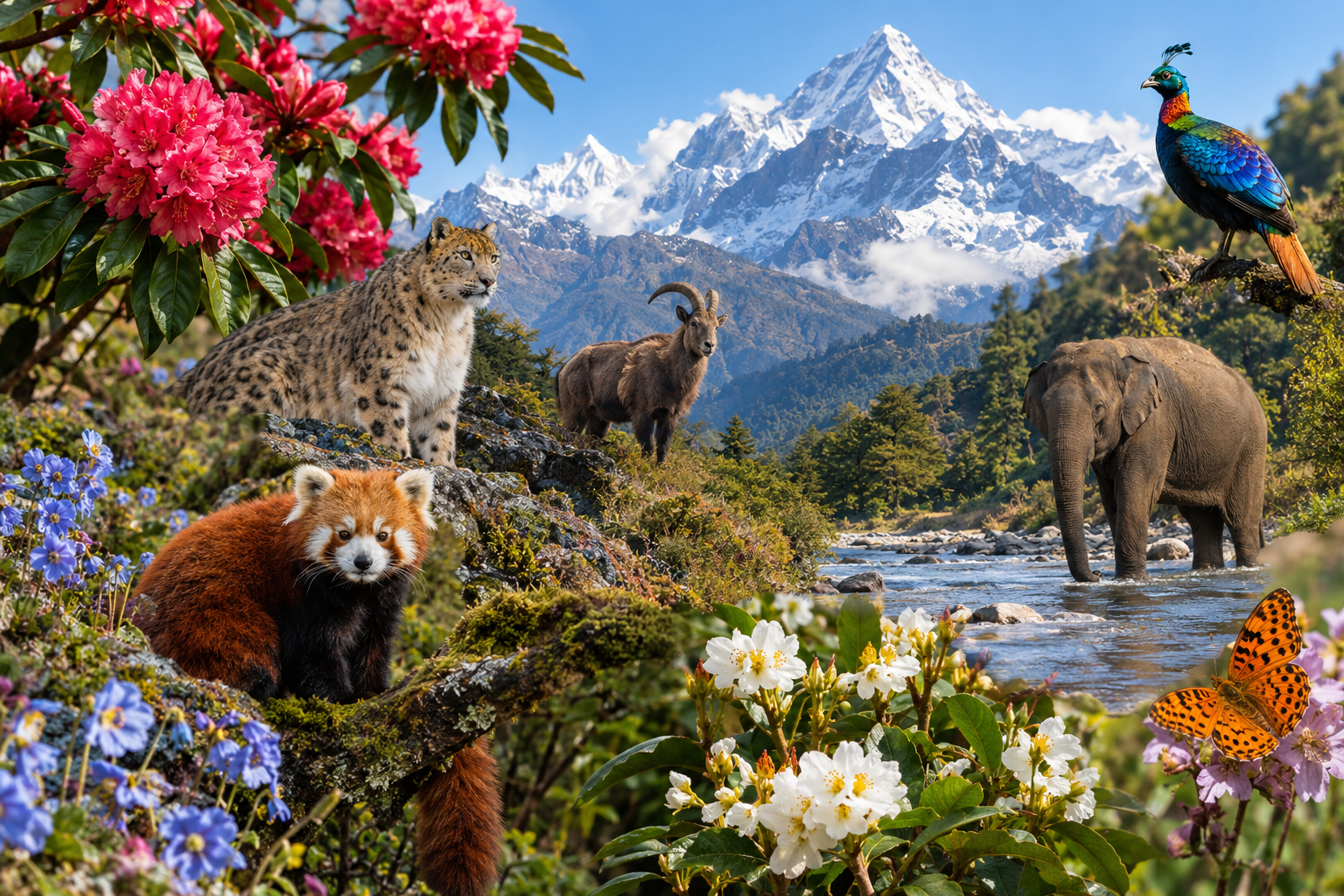
Flora and fauna in Nepal range from the subtropical forests of the Terai to the great peaks of the Himalayas in the north. This makes Nepal one of the most biodiverse countries of its size anywhere in the world.
Between Nepal's geographical extremes, you can find nearly every vegetation type on Earth, from the treeless steppes of the Trans-Himalayan region to the oak, pine, and rhododendron forests of the mid-hills and the great Sal forests of the south.
This richness isn't just a traveler's impression. The numbers back it up: Nepal covers just 0.1% of the world's land area, yet it holds over 3% of the world's known plant species and more than 1% of all animal species. Understanding flora and fauna in Nepal by zone and by region is the best way to know what you'll actually see on your trek.
| Category | Number of Species |
| Mammals |
208 |
| Birds |
867 |
|
Reptiles |
123 |
|
Amphibians |
About 55 |
|
Freshwater fish |
230 |
|
Butterflies |
651 |
| Flowering plants | 284 endemic species |
| Share of the world's flora found in Nepal |
Over 3% |
| Share of the world's fauna found in Nepal |
Over 1% |
| Global land area covered by Nepal | 0.1% |
The Four Vegetation Zones of Flora and Fauna in Nepal
Flora and fauna in Nepal fall into four broad zones, each shaped by altitude, rainfall, and temperature.
The rolling, densely forested hills and broad valleys of the Terai were once renowned across Asia for their abundance of wildlife. Nepal still holds a wider variety of species than almost anywhere else in the region.
1. Tropical Deciduous Monsoon Forest (Terai, below 1,000 m)
This zone covers the Terai plains and the broad flat valleys, or Duns, found between successive hill ranges. The dominant tree species here are Sal (Shorea robusta), often associated with Semal (Bombax malabaricum), Asna (Terminalia tomentosa), and various Dalbergia species, with Pinus roxburghii growing on the higher ridges of the Churia hills, which reach up to 1,800 m in places.
- Tall, coarse elephant grass once covered much of the Dun valleys, though farmland has replaced most of it.
- The pipal (Ficus religiosa) and banyan (Ficus bengalensis) stand out for their distinctive natural characteristics.
- This zone is the richest part of Nepal for wildlife, home to gaurs, wild buffaloes, four species of deer, tigers, and leopards in the forests.
- The grasslands hold rhinoceros, swamp deer, and hog deer, while the rivers support two species of crocodile and the Gangetic dolphin.
- Principal birds include the peacock, jungle fowl, and black partridge, with migratory ducks and geese swarming the Terai's lakes and ponds each winter.
- Terai forests are thick with jasmine, mimosa, acacia, reeds, and bamboo.
- See this zone's wildlife firsthand on a Chitwan Jungle Safari Tour, or browse more options under Jungle Safari in Nepal.
2. Subtropical Mixed Evergreen Forest (Mahabharat Range, 1,000 to 2,400 m)
This zone includes the Mahabharat Lekh, the outer wall of the Himalayan range, where great rivers like the Karnali, Narayani, and Sapta Koshi flow down toward the Terai. It also covers Nepal's middle hills, a maze of ridges and valleys extending north to the foot of the high Himalaya.
Castanopsis indica, often paired with Schima wallichii, dominates alongside Alnus nepalensis, Acer oblongum, and several oak and rhododendron species on the higher, less-deforested slopes.
- Orchids climb tree trunks here, and massive climbing vines smother the canopy above.
- This zone is generally poorer for wildlife than the Terai, with wild boar, barking deer, serow, ghoral, and bears as the main widely distributed mammals.
- A variety of bird species inhabit this middle zone as well, though in smaller numbers than the Terai.
- Many of our Easy and Short Treks pass directly through this forest belt.
3. Temperate Evergreen Forest (2,400 to 3,600 m)
Moving north onto the lower slopes and spurs of the great Himalaya, oak and pine dominate up to about 2,400 m, giving way to dense conifer forest above that: Picea, Tsuga, Larix, and Abies species, with Abies usually confined to the highest elevations and Betula typically marking the tree line.
- Between 3,600 and 3,900 m, rhododendron, bamboo, and maple grow alongside the conifers.
- Forest composition shifts east to west. Coniferous species dominate in the west, while ericaceous (rhododendron family) species take over in the east.
- Wildlife here includes the Himalayan bear, serow, ghoral, barking deer, and wild boar, with Himalayan tahr occasionally spotted on steep rocky faces above 2,400 m.
- The red panda is one of the most interesting mammals of this zone, fairly well distributed in suitable forest above 1,800 m.
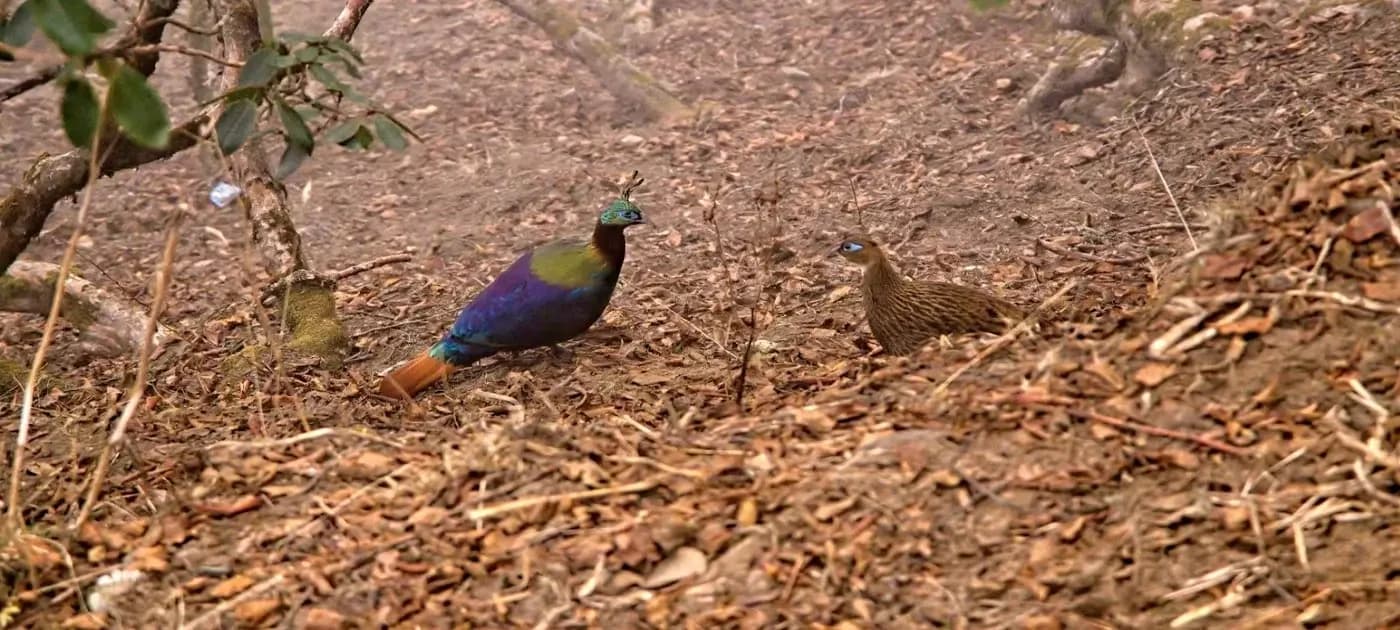
- This zone's rich birdlife includes several spectacular pheasants, including the Danfe, Nepal's national bird.
This zone forms the backbone of our Everest Region Treks and Annapurna Region Treks.
4. Subalpine and Alpine Zone (above 3,600 m)
Above the tree line, rhododendron, juniper scrub, and other low woody vegetation extend to about 4,200 m, giving way to tundra-like grasses, sedges, mosses, and alpine plants wherever enough soil exists. This continues up to the lower limit of permanent snow and ice at around 5,100 m.
- Mammal life thins out considerably here, limited mostly to Himalayan marmots, mouse hares, tahr, musk deer, snow leopards, and occasionally blue sheep.
- Wild yak and great Tibetan sheep once roamed this zone too, and a few may still survive in remote areas like Dolpa and Humla.
- Birdlife includes the lammergeier, snowcock, snow partridge, choughs, and bunting, with redstarts and dippers common along mountain streams.
- Yaks are the only livestock that thrive at this altitude, serving as both pack and draft animals, with their milk made into cheese that keeps edible for months.
This high-altitude zone defines our Manaslu Region Treks and Remote Area Treks.
Taken together, these four zones show exactly what a paradise of flora and fauna in Nepal represents for naturalists, birdwatchers, and wildlife lovers alike.
The National Flower of Nepal
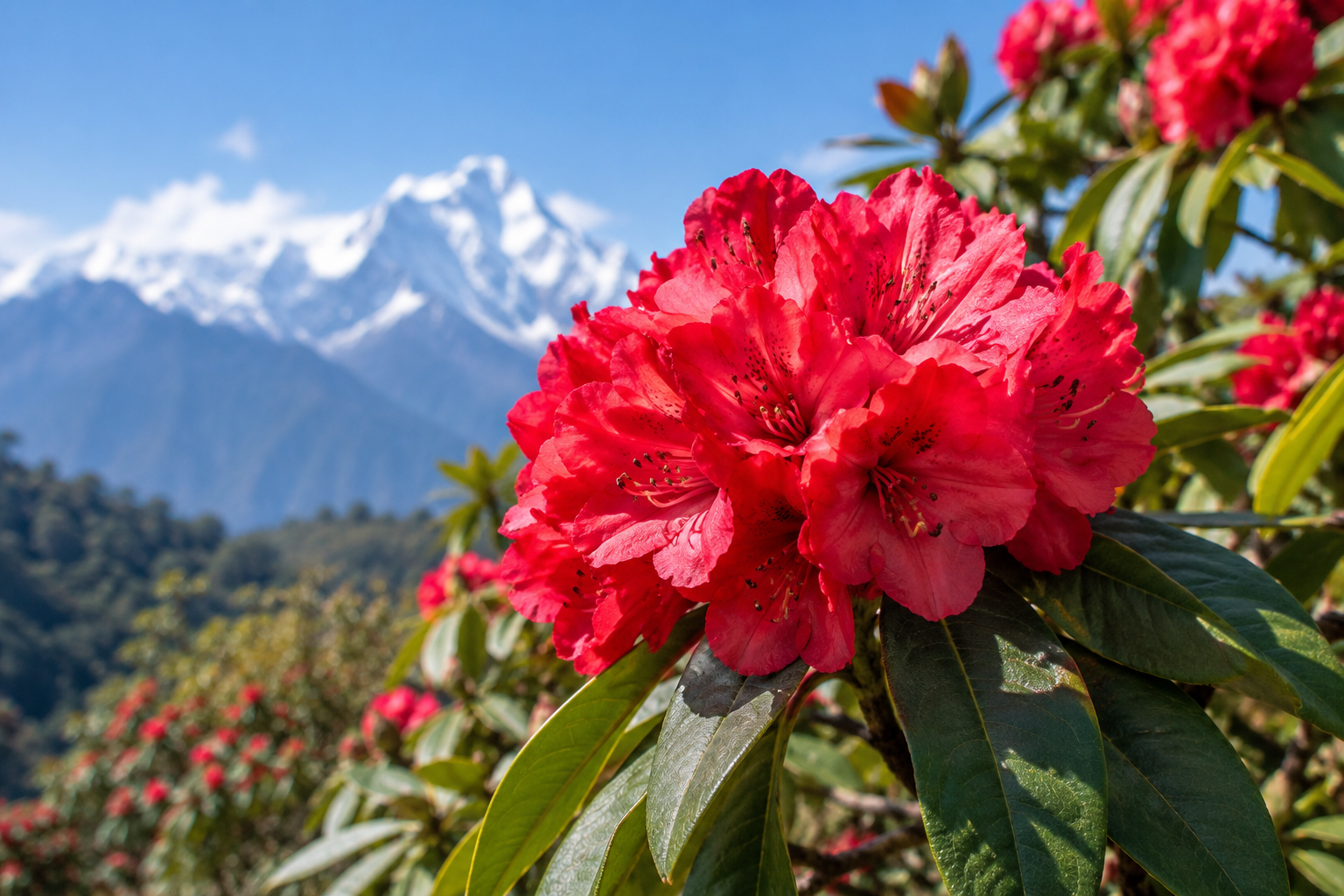
Any discussion of flora and fauna in Nepal has to include the rhododendron, officially declared Nepal's national flower in 1962.
- Known locally as Laligurans, the rhododendron (Rhododendron arboreum) blooms bright red, pink, and white across the mid-hills.
- Nepal is home to more than 30 wild rhododendron species, one of the richest concentrations found anywhere in the world.
- Peak bloom runs from March through April, turning entire hillsides vivid red along popular trekking routes.
- The best places to see this national flower in bloom include Ghorepani-Poon Hill and the lower trails of the Annapurna region.
Time your trip to catch the bloom on our Annapurna Region Treks, and check our Climate of Nepal guide to plan around spring weather.
National Flower, Bird and Animal of Nepal
|
Category |
Species |
Notes |
|
National flower |
Rhododendron (Laligurans) |
Declared in 1962; blooms March to April |
|
National bird |
Himalayan Monal (Danfe) |
Found across the temperate and subalpine zones |
|
National animal |
Cow |
Considered sacred in Hindu tradition |
Wildlife of Nepal by National Park
Flora and fauna in Nepal are protected across a network of national parks and conservation areas, each tied to a different ecological zone.
|
National Park / Reserve |
Region |
Key Species |
|
Chitwan National Park |
Terai |
Bengal tiger, one-horned rhino, gharial crocodile |
|
Bardiya National Park |
Terai |
Bengal tiger, wild elephant, Gangetic dolphin |
|
Sagarmatha National Park |
Everest region |
Snow leopard, Himalayan tahr, musk deer |
|
Annapurna Conservation Area |
Annapurna region |
Red panda, snow leopard, 30+ rhododendron species |
|
Langtang National Park |
Langtang region |
Red panda, Himalayan black bear |
|
Manaslu Conservation Area |
Manaslu region |
Snow leopard, blue sheep, Himalayan tahr |
Explore these parks on a Chitwan Jungle Safari Tour, a Bardia National Park Tour, or any of our Langtang Region Treks.
See Flora and Fauna in Nepal With Global Adventure Trekking
At Global Adventure Trekking, every itinerary passes through at least one of the zones described above. Here's where to look for specific highlights:
- Watch rhododendron forests bloom each spring on our Annapurna Region Treks.
- See Bengal tigers and rhinos up close on a Chitwan Jungle Safari Tour.
- Spot red pandas and musk deer on our Langtang Region Treks.
- Track snow leopard country on our Manaslu Region Treks.
- Combine mountain scenery with wildlife encounters on our Multi-Day Tours.
- Learn how Nepal's terrain created these zones in our Geography of Nepal guide.
- See how season and altitude affect what you'll spot in our Climate of Nepal guide.
Ready to See Nepal's Flora and Fauna?
Contact our team at Global Adventure Trekking, and we'll help you choose the trek or safari that fits the wildlife and plant life you want to experience.
FAQs About Flora and Fauna in Nepal
What is the national flower of Nepal?
The national flower of Nepal is the rhododendron, known locally as Laligurans. It was officially declared the national flower in 1962 and blooms bright red across the mid-hills each spring.
What is the national bird of Nepal?
The national bird of Nepal is the Himalayan Monal, commonly called the Danfe. It lives in the temperate and subalpine forest zones and is known for its brightly colored, iridescent plumage.
How many species of wildlife does Nepal have?
Nepal is home to 208 mammal species, 867 bird species, and hundreds of reptile, amphibian, and fish species. This is remarkable given that Nepal covers just 0.1% of the world's total land area.
What is the best national park to see wildlife in Nepal?
Chitwan National Park offers the best chances to see Bengal tigers, one-horned rhinos, and gharial crocodiles. For a quieter experience, Bardiya National Park offers similar wildlife with far fewer visitors.
Where can I see rhododendrons in bloom in Nepal?
Ghorepani-Poon Hill and the lower Annapurna foothills offer some of the best rhododendron viewing in Nepal. Entire hillsides turn red and pink along these trails each spring.
What is the best time to see flora and fauna in Nepal?
March and April are ideal for rhododendron blooms and general wildlife activity in the hills. Winter months, from December to February, work best for wildlife safaris in the Terai, since animals gather near water sources.
Does Nepal have tigers?
Yes, Nepal has Bengal tigers, mainly found in Chitwan and Bardiya National Parks in the Terai lowlands. These parks represent two of the last strongholds for wild tigers in South Asia.
What is the red panda's habitat in Nepal?
Red pandas live in the temperate forest zone, generally above 1,800 meters in elevation. They're most commonly spotted in the Annapurna Conservation Area and parts of Langtang National Park.
How many rhododendron species grow in Nepal?
Nepal is home to more than 30 wild rhododendron species, one of the richest concentrations of this flower anywhere in the world. This diversity is a major reason the rhododendron was chosen as the national flower.
Is the snow leopard found in Nepal?
Yes, snow leopards live in Nepal's high alpine zones, generally above 3,600 meters. They're found in protected areas including Sagarmatha National Park and the Manaslu Conservation Area.