Everest Mountain Flight Route and the Peaks You Will See
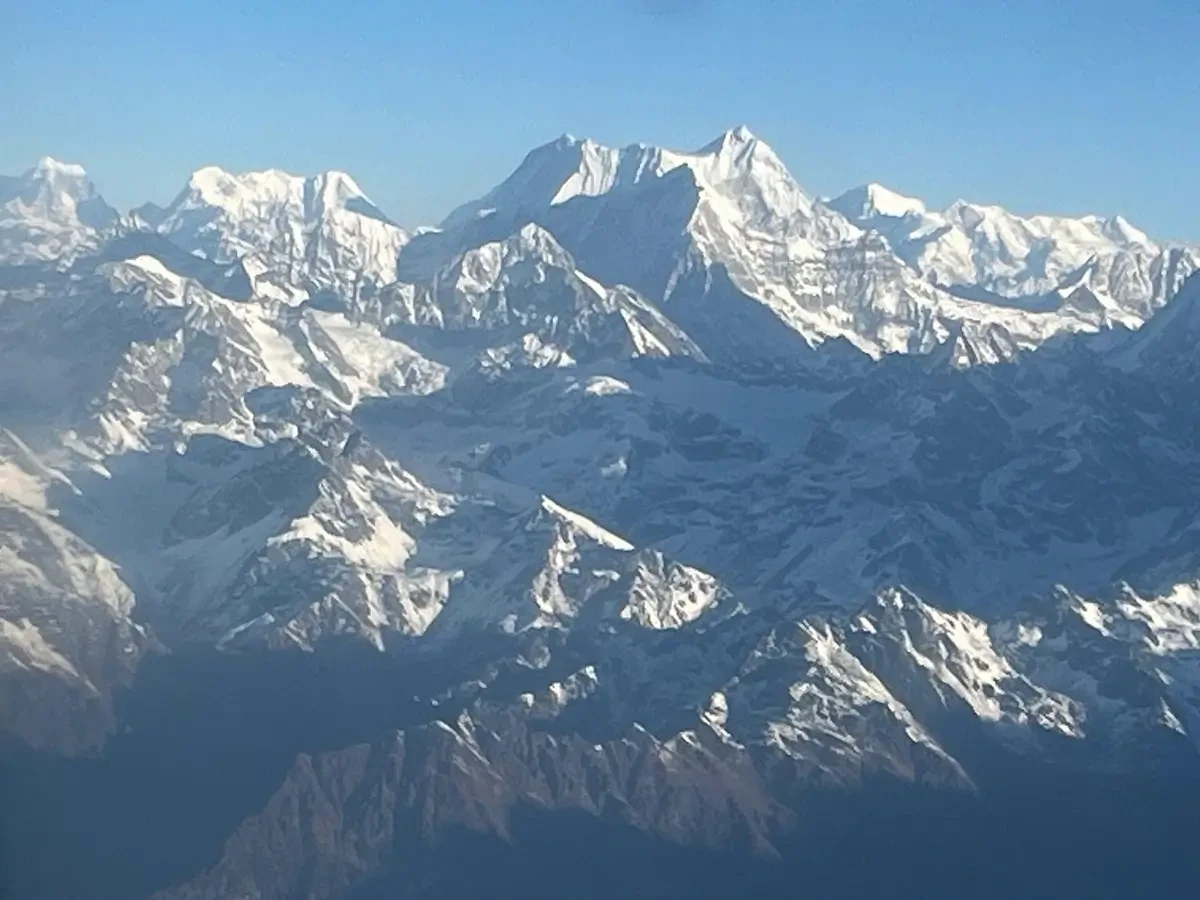
The route of the Everest Mountain Flight follows the Himalayan arc east of Kathmandu. It covers a stretch of about 150 kilometres.
It begins at Langtang, passes the Rolwaling and Khumbu ranges, and ends near Makalu and Chamlang. The aircraft flies near the range and parallel to it. It does not cross over the summits.
Below is a list of the main mountains, from west to east.
|
Peak
|
Height
|
What to know
|
| Langtang Lirung |
7,227 m (23,711 ft) |
A major peak of the Langtang range, close to Kathmandu and among the first on the route |
| Shishapangma |
8,027 m (26,335 ft) |
Lies entirely in Tibet. Appears far to the north |
| Dorje Lakpa |
6,966 m (22,854 ft) |
A sharp peak in the Jugal Himal |
| Gauri Shankar |
7,181 m (23,560 ft) |
Stands near Gauri Shankar on the Tibet border |
| Numbur |
6,959 m (22,831 ft) |
A holy mountain of the Solu region |
| Cho Oyu |
8,188 m (26,864 ft) |
Sixth highest in the world. Its name means “Turquoise Goddess”
|
|
Gyachung Kang
|
7,952 m (26,089 ft) |
Often overlooked. Stands between Cho Oyu and Everest
|
|
Pumori
|
7,161 m (23,494 ft) |
Named “Mountain Daughter”. A beautiful, pointed peak |
| Nuptse |
7,861 m (25,791 ft) |
A long ridge that stands in front of Everest and hides its summit from Base Camp
|
|
Mount Everest
|
8,848.86 m (29,031.7 ft)
|
The highest point on Earth. Local names: Sagarmatha and Chomolungma
|
| Lhotse |
8,516 m (27,940 ft) |
Fourth highest in the world. Connected to Everest by the South Col |
| Ama Dablam |
6,812 m (22,349 ft) |
The graceful, pyramid-shaped favourite of the Khumbu
|
| Makalu |
8,485 m (27,838 ft) |
Fifth highest in the world. A dark, perfect pyramid
|
| Chamlang |
7,319 m (24,012 ft) |
A broad, snow-white massif near your turning point |
On exceptionally clear days, Kangchenjunga (8,586 m), the third-highest mountain in the world, may appear faintly on the far eastern horizon.
The Langtang and Jugal ranges
Your first mountains are the giants to the north of Kathmandu. You will get to see Langtang Lirung glinting in the early light. If this view impresses you, and you want to see Langtang up close, our Langtang Valley Trek walks right beneath it.
The Rolwaling range
Next comes a wild, remote region. Gauri Shankar and Melungtse can be seen above deep valleys and glacial lakes. Few travellers ever walk here. From your seat, you see it all in a few unforgettable minutes.
The Khumbu giants
This is the heart of the Everest Mountain Flight. The Khumbu is the homeland of the Sherpa people. Below the peaks, you’ll get to see the Dudh Koshi Valley and the great Khumbu Glacier.
Somewhere beneath that tumble of ice lies Everest Base Camp, far too small to see from the air. You can walk there on our Everest Base Camp Trek or explore other Everest region treks.
Makalu, Chamlang and the far east
In the end, you’ll get to see Makalu, whose name comes from “Maha Kala”, the Great Black One. Then Chamlang appears, broad and bright. This is around where the aircraft turns, though the exact point depends on the airline and the day.
Where Do You Land After the Everest Mountain Flight?
You land exactly where you began: Tribhuvan International Airport in Kathmandu. The Everest Mountain Flight is a sightseeing loop. It does not land at Everest, at Lukla, or at any mountain airstrip. The turboprop aircraft used on this route cannot use the short airstrips of the Khumbu, so the flight never lands near Everest.
If you want to touch down in the high Himalayas, a helicopter tour is the answer. Our Luxury Everest Base Camp helicopter tour with a Kala Patthar landing lets you stand at 5,545 metres in the Khumbu.
How Long Is the Everest Mountain Flight?
The Everest Mountain Flight takes about one hour in the air. Most operators describe it as 50 to 60 minutes from take-off to landing.
Here is a simple breakdown:
- Early part: Take-off, climb, and flight east over the green foothills.
- Middle section: The longest part, flying alongside the range. This is when you see Langtang, Rolwaling, and Everest.
- Turn: A wide arc near Makalu and Chamlang, so both sides of the cabin see the mountains.
- Final part: The return along the same corridor and landing in Kathmandu.
From hotel pickup to hotel drop-off, allow a few hours. Flights depart in the early morning, shortly after sunrise, because mornings give the clearest air and the calmest skies.
Which Side Should You Sit On?
This is one of the most asked questions about the Everest Mountain Flight. The answer is simple: it does not matter. Every passenger gets a window seat.
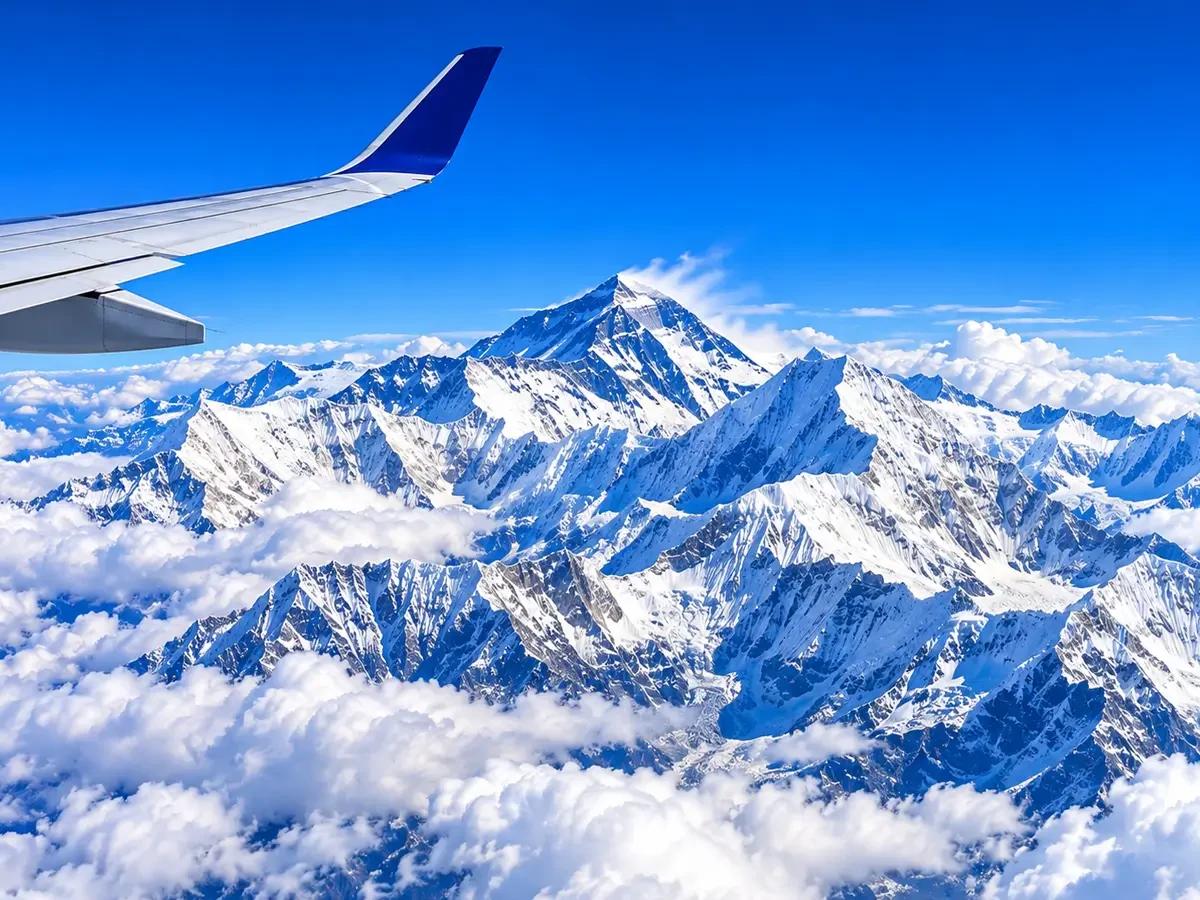
On the way out, the mountains are on the left-hand side of the aircraft. After the turn, they are on the right. Everyone sees Everest, both coming and going.
Still, a few small tips help. Sit with a friend and agree to swap views after the turn. Keep your camera ready and do not spend the whole flight looking through a lens. Put it down for a minute and just look.
How to Spot Everest from the Window
Everest does not always look like the tallest mountain. From the aircraft, nearer peaks can seem higher. Here is how to find it.
Look for the dark pyramid: Everest’s summit is dark rock, not bright snow. It rises behind the long, pale Lhotse–Nuptse wall.
- Watch for the plume: On windy days, a banner of snow streams from the summit.
- Use your neighbours: Lhotse lies directly beside Everest. Nuptse is the long ridge in front. Pumori sits to the west, and Ama Dablam is the graceful peak with a hanging glacier to the south.
- Check your map: The Himalayan peaks map lists the mountains in the order they appear.
- Ask the crew: They announce the main peaks and will gladly point Everest out.
- Zoom in: A phone zoom or a short telephoto lens brings the summit closer.
Take a moment to look without a screen, as your eyes will find details that photos miss.
Aircraft and Airlines on the Everest Mountain Flight
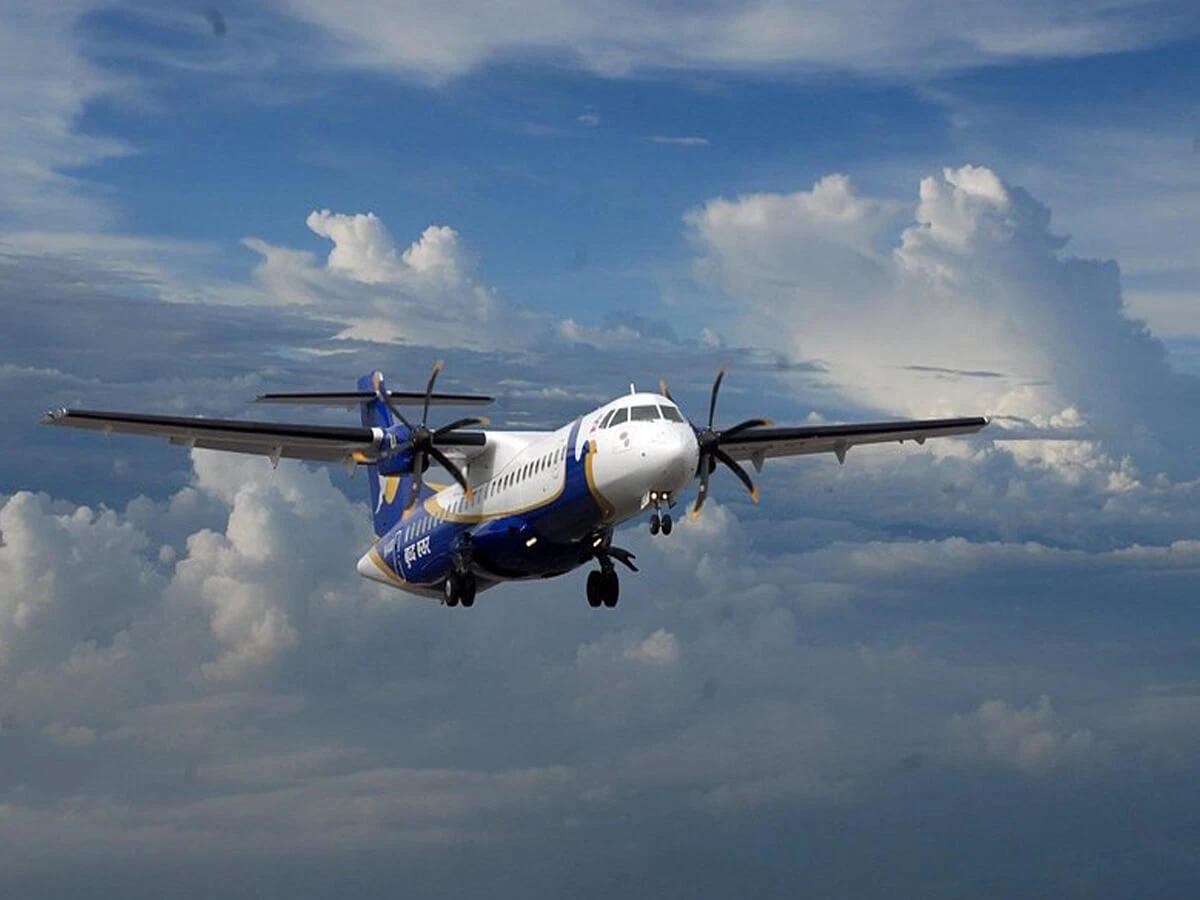
Mountain flights are operated by Nepal’s licensed domestic airlines. Buddha Air and Yeti Airlines are two well-known operators. Their aircraft are modern twin-turboprop ATR planes. The ATR 42 and ATR 72 are the types most often used.
The cabin is pressurised, so you do not feel the thin air outside. Cruising altitude is roughly 20,000 to 25,000 feet. Airlines limit the number of passengers on mountain flights so that everyone has a window. Pilots fly this route often. They know the mountain weather well.
Airlines, aircraft, and schedules can change by season. We confirm your airline and departure time when you book.
The Himalayas in Brief: Why This View Is Unique
The mountains you see from the plane grow and appear closer every moment. About 50 million years ago, the Indian plate began pushing into Asia. The land buckled and rose, and that pressure continues today, and the range still lifts by a few millimetres each year.
The Himalayan arc stretches roughly 2,400 kilometres across several countries. Nepal holds eight of the world’s fourteen peaks above 8,000 metres, some of them shared with its neighbours.
Within about 200 kilometres, the land climbs from low, warm plains to the summit of Everest. No other country has such a dramatic change in so short a distance. To learn more, read our guide to the geography of Nepal.
The Story of Everest: Names, Measurements and Milestones
Everest has many names. Nepalis call it Sagarmatha, meaning “Forehead of the Sky”. Tibetans call it Chomolungma, meaning “Goddess Mother of the World”. British surveyors in India first recorded it as Peak XV. In 1865, it was named Mount Everest after Sir George Everest, a former Surveyor General of India.
Its height has been measured again and again. In 2020, Nepal and China jointly announced the official height of 8,848.86 metres (29,031.7 ft).
On 29 May 1953, Tenzing Norgay, a Sherpa, and Edmund Hillary of New Zealand made the first confirmed ascent. Since then, thousands have followed. Yet the mountain still commands respect.
Seeing Everest from the air carries a special feeling. You are looking at the same mountain that surveyors measured with theodolites and climbers dreamed about for decades.
Who Is the Everest Mountain Flight For?
The Everest Mountain Flight suits more people than almost any other Himalayan experience. It is especially loved by:
- Short-stay travellers: If you have only two or three days in Nepal, this is the best use of a morning.
- Families with children: Kids love the aircraft, the clouds and the “mountain map” game. There is no walking and no risk of exhaustion.
- Senior travellers: Parents and grandparents can see Everest without strenuous effort.
- Travellers with limited mobility: The experience needs only a short walk through the airport.
- Photographers: Large cabin windows, soft sunrise light and dramatic peaks make a perfect combination.
- Couples and honeymooners: Watching the sunrise paint Everest together is deeply romantic.
- First-time visitors to Nepal: It is a gentle, spectacular introduction to the Himalayas.
- Trekkers: Some fly before a trek as a preview. Others fly afterwards to see the whole range from above.
- Anyone worried about altitude: The cabin is pressurised, and you return to Kathmandu within the hour.
- A note on expectations: Everest is still far away from your window. It appears as a dark pyramid beyond the great Lhotse–Nuptse wall. It is magnificent, but it is not “within touching distance”.
If you want to land beside the mountains, consider our Luxury Everest Base Camp Helicopter Tour with Kala Patthar Landing instead.
By Helicopter vs Plane: Two Ways to See Everest from the Sky
Everest can be seen from the air in two very different ways. One is a helicopter that flies low and can land in the high Khumbu, and the other is a fixed-wing aircraft that carries you beside the range and back to Kathmandu.
Everest by Helicopter
A helicopter takes you deep into the Khumbu, where the mountains rise right beside the cabin. As it flies lower and slower than an aircraft, you look straight into valleys, glaciers, and Sherpa villages that a plane can only show from far away.
Our Luxury Everest Base Camp Helicopter Tour with Kala Patthar Landing is a one-day journey from Kathmandu that takes about five hours in total. You land at Kala Patthar, the famous viewpoint at 5,545 metres, and explore the Everest Base Camp area before flying back.
The great advantage of a helicopter is the landing. You can stand on the mountain, which no plane can offer. The trade-offs are a higher cost, a strong dependence on clear weather, and the altitude itself, since even a short stay above 5,000 metres can affect some travellers.
Helicopters also play a part in our Luxury Everest Base Camp Trek with Helicopter. On that trek, the helicopter collects you from Gorak Shep rather than from Everest Base Camp, because Base Camp itself is reached on foot.
Everest by Plane: The Everest Mountain Flight
The Everest Mountain Flight takes a different approach. A pressurised turboprop flies beside the Himalayan range for about an hour and returns to Tribhuvan International Airport, so you never land in the mountains.
From your window seat, you see about twenty peaks, including Everest, Lhotse, Makalu and Cho Oyu. The view is visible across roughly 150 kilometres of the range, so you understand how the whole Himalayan wall fits together.
As the aircraft stays farther from the peaks, it shows the full panorama at once, while a helicopter shows fewer mountains in closer detail. A plane is also the gentlest choice. There is no landing at altitude, no permit, and no fitness needed, which suits families, seniors, and travellers with only a short stay.
Everest Mountain Flight (One Morning by Plane)
The Everest Mountain Flight needs only one morning, with no trekking and no permit. You fly for about an hour beside the range from a window seat, see Everest and about twenty other peaks, and return to Kathmandu.
Unlike both treks, it asks nothing of your body and carries no altitude risk, because the cabin is pressurised. It costs the least of the three, and it works well for children, seniors and short stays.
What you give up is closeness. You do not walk through the villages, stand at Everest Base Camp or land near the peaks, and Everest appears as a distant pyramid.
In return, you see the whole range at once, which no trek can show you. Many travellers fly first as a preview and trek later, or fly after a trek to see their route from above.
Sacred Mountains and the People Beneath Them
For the people of the Himalayas, mountains are not just rock and ice. They are homes of deities. Many Sherpas and Tibetan Buddhists see Chomolungma as a goddess. Gauri Shankar is sacred to Hindus and Buddhists. Hindus link it with Lord Shiva and Goddess Parvati.
Below your flight path live Sherpa, Rai, Tamang and other communities whose lives are shaped by these peaks. Their prayer flags, monasteries and festivals honour the mountains daily. Respecting this meaning will deepen your journey.
Learn more about the people of Nepal and the religion of Nepal on our travel guide pages.
What an Everest Mountain Flight Feels Like
Facts tell you what you will see, but they cannot tell you how it feels. So let us try to provide a vision of what you see.
You wake in the dark. The air in the lane outside is cool and still. There is a small knot of excitement in your stomach. At the airport, people speak in whispers. Nobody says it aloud, but everyone feels it. Something rare is about to happen.
The wheels leave the runway, and something loosens in your chest. Kathmandu falls away, with its horns, its smoke and its thousand rooftops. The noise of the city is replaced by the steady hum of engines and the beat of your own heart. You are rising, and you can feel it.
Then you see it. A thin, bright line floats above the haze, as if painted onto the sky. You think it is a cloud, and then you notice the edge is too sharp. It is not a cloud, but the Himalayas, and their feet are hidden in mist, so they seem to hang in the air.
The feeling is disbelief. Your mind says, “That cannot be real.” Your eyes say, “Look again.”
- The moment Everest arrives
The crew speaks quietly. “Everest, on your left.” You lean to the glass, search, find the wrong peak, and search again.
Then you see it. A dark, calm pyramid that stands slightly higher than everything around it. A thin plume of snow streams from the summit like a pennant that looks historic and beautiful.
You do not feel triumph. You feel small, and it is the good kind of small. The kind that quiets worries. This summit rock was once the floor of an ancient sea. Marine fossils have been found near its top. Now it rises beyond the airliner’s window, nearly 8,849 metres above sea level, where time itself seems to bend.
Many travellers say their throat tightens. Some laugh, some cry, but all of them whisper “Wow.”
The light changes every minute. At first, the summits glow pink, the famous alpenglow. Then they turn gold. Then they blaze white against a sky of deep, dark blue. Below, the valleys stay in cool blue shadow. Glaciers curve like frozen rivers. Ridges fold into each other like waves. It feels like looking at the first morning of the world.
Something strange happens in the cabin. People stop talking. Strangers share a look. A child presses his/her nose to the glass. A grandfather folds his hands. Even the cameras go quiet for a while.
You realise you have been holding your breath. You let it go. You feel calm and wide awake at the same time.
- The return and the afterglow
The aircraft turns. The mountains swing to the other window. You get a second chance, and you take it with new eyes. The first look was shock. The second look is understanding.
When you land, the world looks the same, but you do not. The tea tastes better and the morning feels longer. For the rest of your trip, you will glance east now and then, toward a horizon you have already touched with your eyes.
That is the real gift of the Everest Mountain Flight. It is not just a view but a feeling you carry home.
Why the Aerial View Is Special
There is a reason travellers return from this flight so moved. The air gives you a view the ground never can. This aerial view is better for:
- Seeing the whole range at once: From a trail, you see one valley at a time. From the plane, you see a 150-kilometre wall of snow and ice in a single glance.
- Spotting the summit of Everest: At Everest Base Camp, the summit is hidden by the surrounding ridges. The classic summit view on foot comes from Kala Patthar. In the air, the whole pyramid stands before you.
- Understanding scale and structure: You see how Everest rises beside Lhotse and Nuptse. You see how the Khumbu, Rolwaling and Langtang regions connect. It turns a list of names into a living map.
- Seeing glaciers and glacial lakes: Rivers of ice and pools of turquoise water look best from above. You may glimpse lakes such as Tsho Rolpa in the Rolwaling region.
- Panoramic photography: The wide horizon, soft sunrise light, and clean air make ideal conditions for sweeping images.
- Travellers who cannot trek: Age, health, time, or fear of altitude need not stand between you and Everest.
- Looking above the weather: On many mornings, clouds fill the valleys while the peaks shine in clear sunlight. You see the “sea of clouds” from above it.
- Remembering a trek: If you have walked in the Khumbu, the flight lets you trace your own route from the sky.
Of course, the plane cannot give you everything. It cannot give you the smell of juniper smoke, the warmth of a Sherpa teahouse, or the pride of walking to a high pass. For those, you will need boots. Our Everest Base Camp Trek is waiting.
Instructions and Services Provided on the Flight
Safety and comfort come first. Here is what you can expect before and during the flight.
What the airline crew provides
- A safety briefing on seat belts, exits, and cabin rules before take-off.
- A Himalayan peaks map that lists the mountains in the order you will see them.
- Live commentary from a crew member who points out and names each major peak.
- A guaranteed window seat for every passenger.
- Seat swapping after the turn, so you can enjoy both sides of the cabin.
- A short cockpit visit, where flight conditions and the crew allow.
- A flight certificate to mark your Everest flight.
Rules to follow on board
- Keep your seat belt fastened during take-off, landing, and any turbulence.
- Switch your phone to airplane mode. This also protects your battery for photographs.
- Stay in your seat unless the crew invites you to the cockpit.
- Follow the crew’s instructions about moving between seats.
- Be kind to your neighbours. Everyone wants the same view.
What Global Adventure Trekking provides
- Hotel pickup and drop-off by private vehicle.
- A clear message the evening before, with your exact pickup time.
- Help with check-in and boarding questions.
- Weather updates and rebooking if the flight is delayed or cancelled.
- Simple photo and packing advice, so you feel ready.
Best Time for the Everest Mountain Flight
The Everest Mountain Flight operates throughout the year. The mountains are always there. What changes is the clarity of the air.
| Season |
Months |
What to expect |
| Autumn |
October to November |
The best time. Washed skies after the monsoon, crisp air and deep blue horizons. Also the busiest, so book early. Late September is often good too.
|
| Winter |
December to February
|
Very clear mountain views and sharp light. Mornings are cold. Occasional valley fog in Kathmandu can delay take-off.
|
| Spring |
March to May |
Warmer, with good views in March and April. Haze builds toward May. |
| Monsoon |
June to August |
Clouds and rain reduce visibility. Flights still run when conditions allow. The earliest morning flight gives the best chance. |
Best time of day: Early morning, always. The air is calm, the skies are clearest, and the sunrise light is magical. By late morning, clouds often start to build around the peaks.
For a deeper look at weather through the year, see our guide to the climate of Nepal. As the weather controls everything, we suggest keeping one flexible morning in your plan. Then, if the first flight is delayed, you still have a second chance
How to Book Your Everest Mountain Flight: Step by Step
Booking is simple. Here is how it works.
- Choose your date: Pick a morning in your Nepal plan. In October and November, book as early as you can. Keep a spare morning if possible.
- Send us your details: Share your name as it appears on your passport, your nationality, the number of travellers, and your hotel in Kathmandu.
- Confirm and pay: We will confirm the price and payment options with you when you enquire.
- Receive your pickup time: The evening before, we message you with your exact pickup time and what to bring.
- Fly: Meet our driver in the lobby, and let the morning begin.
- If the weather interferes, we rebook you on the next available flight and keep you informed.
Ready to start? Visit our contact page or plan your trip online.
Photography Tips for Your Flight
You do not need a professional camera. A smartphone can capture beautiful images. These tips will help:
- Press your lens close to the window to reduce reflections. Wear dark clothes so you do not reflect in the glass.
- Turn off the flash. It only bounces off the window.
- Use a fast shutter speed. The plane is moving. Aim for 1/1000 second or faster on a camera.
- Shoot wide and zoom. A wide shot shows the range. A zoom shows Everest’s pyramid.
- Tap to expose for the sky on a smartphone, so the snow does not turn grey.
- Bring a spare battery and memory card. Cold air and excitement drain both.
- Put the camera down for a minute. The best part of this flight is the feeling, not the file.
How to Prepare for Your Everest Mountain Flight
Preparation is simple. A few small steps make the morning smooth.
- Check your visa: Make sure your Nepal entry papers are in order. See our entry permit and visa procedures pages.
- Carry your passport: Airlines check identification at check-in.
- Dress in light layers: The cabin is comfortable, but early mornings in Kathmandu are cool. Add a light jacket.
- Wear sunglasses to reduce glare from the snow.
- Eat lightly: A little tea and a snack are enough before you fly.
- Charge your devices: Fully charge your phone and bring a power bank so you never miss a photo.
- Take motion-sickness tablets if you are prone to it. The flight is usually smooth, but mountain air can be bumpy.
- Travel light: You do not need luggage. Leave large bags at your hotel.
- Sleep well: The wake-up time is early.
If you are planning your wider trip, our Nepal travel info and travel guides will help.
Is the Everest Mountain Flight Safe?
The Everest Mountain Flight is operated by licensed Nepali domestic airlines on a route their crews fly regularly. The aircraft are modern, pressurised turboprops with large cabin windows.
Flights go only when visibility and weather are suitable. If conditions are poor, the airline delays or cancels. Safety always comes before the schedule.
Honest planning also matters. Mountain weather can change quickly. Keep your plans flexible. Buy travel insurance that covers flights and delays, and choose a reliable local team. We keep a close watch on conditions and stay in touch with you throughout the morning.
Everest Mountain Flight with Children and Senior Travellers
This is one of the few Himalayan experiences that three generations can share. A little planning makes it smoother.
With children:
- Explain the early start the night before, and let them sleep in the car if needed.
- Give a small drink or snack during take-off and landing. It helps young ears.
- Bring the mountain map and ask them to find Everest. Kids love a mission.
- Keep a light jacket handy. Cabin air can feel cool.
- Airlines usually treat ages 2 to 11 as children for fares. Tell us the ages when you book.
With senior travellers:
- The walk from the terminal to the aircraft is short, and boarding usually involves a few steps. Tell us in advance if you need extra assistance, and we will request it.
- Wear comfortable shoes and warm layers for the early morning.
- Carry any regular medication in your handbag.
- Take your time at the window. There is no rush to see everything at once.
If you or a family member has a heart or lung condition, or if you are pregnant, please speak to your doctor before you fly.
Turn One Morning into a Longer Himalayan Journey
The flight pairs beautifully with other experiences. Here are some ideas from our tours in Nepal and one-day tours and activities:
- The same afternoon: Join our Kathmandu Day Tour to four UNESCO World Heritage Sites, or explore with our Patan and Bhaktapur Day Tour.
- A gentle trek: Choose from our easy and short treks to stay in the mountains a little longer.
- A full Everest adventure: Walk to the base of the world’s highest peak on our Everest Base Camp Trek. Or climb with our Island Peak Climbing and Mera Peak Climbing trips.
- Everest from the north: See the Tibetan face of the mountain on our Tibet Everest Base Camp Tour.
- A helicopter option in Pokhara: Fly to Annapurna on the Annapurna Base Camp Helicopter Tour from Pokhara.
- More thrills: Try paragliding in Nepal or a Chitwan Jungle Safari.
Want it all in one plan? Use our Customize Trip page, and we will build a journey around your dates.
Sample Nepal Plans That Include the Everest Mountain Flight
The flight slots neatly into a short or long stay. Here are three simple ideas. Every plan can be customised.
A 3-day Kathmandu highlights stay
- Day 1: Arrive in Kathmandu. Join the Kathmandu Day Tour to see four UNESCO World Heritage Sites.
- Day 2: Take the Everest Mountain Flight at dawn. Spend the afternoon on the Patan and Bhaktapur Day Tour.
- Day 3: Shop in Thamel, then depart.
A 5-day culture and wildlife stay
- Day 1: Arrive in Kathmandu and rest.
- Day 2: Fly beside Everest in the morning. Explore Kathmandu’s temples after breakfast.
- Days 3 to 5: Join the 3-day Chitwan Jungle Safari.
After the safari: You return to Kathmandu, ready for your onward journey.
The trekker’s preview
- Day 1: Arrive in Kathmandu.
- Day 2: Take the Everest Mountain Flight as a preview. Meet your guide and prepare for the trail.
- Following days: Begin our Everest Base Camp Trek and recognise the peaks you saw from the sky.
Prefer something gentler? See our easy and short treks.
Your Morning with Everest Is Waiting
Some journeys take weeks, but an Everest Mountain flight takes an hour. Yet the Everest Mountain Flight gives you something that no photograph, no documentary, and no story can: the sight of the highest mountain on Earth, glowing in the first light of day, as seen by your own eyes.
Ready to see Everest? Choose your date, reserve your window seat, and let our team handle the rest. Talk to us today through our contact page, or explore more Everest region treks for your next chapter in the Himalayas.
Book your Everest Mountain Flightwith Global Adventure Trekking, and let the roof of the world come to you.